Today's
EarthStation1.com 15% Off Commemorative Memorial Title: Command
Performance WWII Old Time Radio Series MP3 DVD, Download, USB
Today, June 14, 2026
June 14: National Bourbon Day: -- What
happens when you combine corn, limestone, white oak, fire, and
time? You get one of the best-loved alcoholic spirits in American
history: bourbon. Since June 14 is National Bourbon Day, a little
history is in order. In the mid-1700s, Scots-Irish settlers in the
area that is now Virginia and Kentucky began distilling corn - the
only grain native to the area, but one which made for excellent
whiskey owing to its sweetness. Another geographical factor was
also beneficial to the birth of bourbon.The Limestone Shelf
region, where all major American whiskeys are still made today,
imbued the local water with calcium while filtering out iron.
Turns out that high-calcium, low-iron water is excellent when it
comes to makin' moonshine. We have a clergyman-cum-distiller named
Elijah Craig to thank for the third major piece of the bourbon
puzzle. In the late 1780s, Craig was using old fish barrels to
store his spirits.Not surprisingly, fish-flavored wood did not
enhance the whiskey's taste, so Craig started purifying the
white-oak barrels by charring the inside. Then he stamped the
barrels with their county of origin (Bourbon County, in his case)
and sent them on a 90-day trip down to New Orleans. The charred
oak and three-month travel time combined to mellow the whiskey and
give it a smooth, smoky, oaky flavor. WhenNew Orleanians requested
more of "that whiskey from Bourbon," the name and the
spirit were born. On Sale @ 15% Off Discount Till Midnight PT!
https://store.earthstation1.com/command-performance-in-world-war-ii-radio-broadcasts-mp3-c3.html
Today's
EarthStation1.com 15% Off Commemorative Memorial Title: World War
I: An Audio History MP3 Set CD, Audio Download, USB Drive
Today, June 14, 2026
June 14: National Cucumber Day: -- A day
to enjoy fresh cucumbers all day long! Join us as we crunch on
this crisp summer favorite and enjoy the fruits of summer. You can
almost taste the crisp, watery goodness of a cucumber during the
summer months. With fresh fruits and vegetables at our fingertips,
we feel very little guilt indulging in this salad favorite.
Whether we grow them in our garden or purchase them at a local
farmers market, we love the freshness a cucumber adds to our
diets. Most people think cucumbers are a vegetable. In fact, they
are actually a fruit in the watermelon family Cucurbitaceae.
Cucumbers are normally a long and have a cylindrical shape, and
are grown in different sizes. There are also around 100 different
types of cucumbers around the world. Most cucumbers have green
flesh with a white inside. The Lemon Cucumber has yellow skin and
a tart taste. However, the Albino cucumber is a rare heirloom
cucumber grown by seed savers. A seed saver is someone who saves
seeds year-to-year and prevents cross-pollination with another
seed variety. Cucumbers have been cultivated for nearly 3,000
years originating in Asia. It is unclear how or when cultivation
was introduced to Ancient Greek and Roman Empires, but records
show both upper and lower class people of those times were
cultivating cucumbers as part of their diet. Europeans would bring
cucumbers to the U.S. some time during exploration. Benjamin
Watson's Heirloom Vegetables book stated "in 1539 DeSoto
found Indians in Florida growing cucumbers that were "better
than those of Spain." Cucumbers are a common salad food.
However, cucumbers are a main ingredient in the puree of gazpacho
soup. In addition, tea houses in Britain serve cucumber sandwiches
with tea because its lightness pairs well with afternoon tea.
Though most people slice cucumbers and eat them in salads, many
people use them for pickling. Pickling possibly dates back as far
as the Mesopotamians who would preserve cucumbers in a brine
solution. Today, Americans consumer almost 10 pounds of pickles
per person in one year! Unsurprisingly, Kosher dill pickles have
been a favorite among households since the 19th century thanks to
Eastern European Jews emigrating to the U.S. On Sale @ 15% Off
Discount Till Midnight PT!
https://store.earthstation1.com/world-war-i-an-audio-history-wwi-mp3-c3.html
Today's
EarthStation1.com 15% Off Commemorative Memorial Title: Lost Howdy
Doody Childrens TV Shows DVD, Video Download, USB Drive
Today, June 14, 2026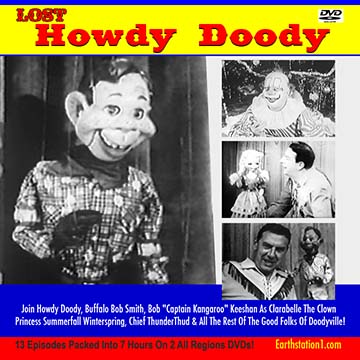
June 14: National Cupcake Day: --
Cupcakes are truly the little hand-sized delights of the
confectionery world, coming in as many variations as the
imagination can dream up. Topped with everything from sprinkles to
frosting to candies, cupcakes are absolutely delightful! National
Cupcake Day is a sign that it's time to enjoy one of the world's
most delightful treats, the cupcake. It's like heaven in just a
few bites. Cupcakes, surprisingly, haven't been around as long as
most people might suspect. That isn't to say that they don't have
a long and respectable history. Cupcakes were first unofficially
invented in 1796 when Amelia Simmons published a recipe for "a
light cake to bake in small cups" in American Cookery. But it
wasn't until 1828 that these little beauties would come to be
known as 'cupcakes', a term coined by Eliza Leslie's cookbook
recipes. Back in the early days of cupcakedom, these delights were
made in distinguished ceramic cups. In fact, a happy little
remnant of this practice can be found in the modern 'mug cake',
where a ceramic mug is filled with ingredients and placed in a
microwave to create a quick and moist cake. Of course, things have
advanced a bit since the days of cups of heavy pottery, and these
days it is super easy to find cupcake "pans" made of
everything from stainless steel to silicone rubber, each with
their own advantages. However they are prepared, cupcakes are sure
to be a hit at every venue. There are even gluten-free and vegan
varieties of these cakes for those who are on restrictive diets.
While these options may not sound immediately appetizing, rest
assured that some of these recipes are positively
taste-bud-blowing. On Sale @ 15% Off Discount Till Midnight PT!
https://store.earthstation1.com/lost-howdy-doody-shows-2-dual-layer-dvd-se2.html
Today's
EarthStation1.com 15% Off Commemorative Memorial Title: The Best
Of Spike Jones 3 Volume Set DVD, Video Download, USB Drive
Today, June 14, 2026
June 14: National Pop Goes The Weasel
Day: -- This day celebrates the nursery rhyme that we all have
been singing since we were kids. It has been around for almost 300
years now. This day is a great throwback to those childhood
memories. Not many would know that the rhyme was a comment on the
social-political scenario during that era and the poverty that
people had to endure. The 'Pop Goes The Weasel' rhyme originated
in the 1700s. It mentions the Eagle Tavern, also known as the
Eagle Freehold Pub, which is situated on London's City Road. The
pub was shut down and turned into a music room in 1825 until 1901
when it was rebuilt as a public house and still exists to date. A
boat called Pop Goes The Weasel took part in the Durham Regatta
way back in June of 1852. In the same year, in December, the rhyme
rose to public prominence. It was referred to as a social dance in
and around England. In Ipswich, a country dance ended with this
rhyme on December 13, 1852. Soon afterward, on December 24, 1852,
the rhyme was introduced to the royalty and their private soirees.
By December 28, 1852, it started being included in publications
and was being advertised throughout England. At first, it was just
a tune, and only later the lyrics were added. It even crossed the
Atlantic Ocean and went from England to America in the late 1850s.
The rhyme soon became popular there as well, although the words
were still British to an extent. Therefore U.S. lyrics were
written to be slightly different from the original, however, the
rhyme retained the same tune. On Sale @ 15% Off Discount Till
Midnight PT!
https://store.earthstation1.com/the-best-of-spike-jones-dvd-set-all-3-volumes-2-dis32.html
Today's
EarthStation1.com 15% Off Commemorative Memorial Title: 33 1/3
Revolutions Per Monkee (1969) The Monkees DVD MP4 Download USB
Today, June 14, 2026
June 14: Monkey Around Day: -- An annual
celebration that encourages everyone to set aside their worries
and toss out their inhibitions. Monkey Around Day is a day to just
goof off and do whatever comes to mind. Maybe you have a wild idea
that you've always wanted to try but were afraid to. Today's the
perfect opportunity to be brave and safely have some fun. You'll
be pleased you did it tomorrow. So, go with the flow, and spend
some time idly without being too serious. Bob Matthews of
Rochester, New York, and founder of Holiday Insights, came up with
the idea for this fun day in 2016. In celebration of his daughter
Kimberly's birthday, he chose June 14. Kimberly adored monkeys and
anything related to them since she was a small child. Bob claimed
that "his family was subjected to far too much stress. At the
very least, they needed one day to put their stress, troubles, and
worries aside and just relax and monkey around." The
expression "monkey around" means to go with the flow, do
whatever you like (if it's legal and safe of course,) have some
leisure time and just fool around. Although the origin of the
phrase is unknown, the physical imagery of monkeys playing around
is most likely the source of this idiom. The phrase is also linked
with 'monkey business,' the origin of which can be traced back to
a previous term, 'monkeyshine,' coined in 1832. The term
'monkeyshine' refers to a harmless prank or mildly boisterous
conduct based on their fun personality, it also meant
"disreputable behavior."Monkey Around Day serves as a
reminder to not take life too seriously. Every one of us needs
some time to rest or to play around after a long week at school or
at work. The phrase is most likely derived from our observations
of monkeys in zoos. They appear to have a carefree attitude toward
life. On Sale @ 15% Off Discount Till Midnight PT!
https://store.earthstation1.com/33-13-revolutions-per-monkee-dvd-1969-tv33131969.html
Today's
EarthStation1.com 15% Off Commemorative Memorial Title: TV
Commercials: The Cable Age Classics I DVD, Download, USB Drive
Today, June 14, 2026
June 14: World Blood Donor Day: -- An
event that raises awareness to the importance that donating blood
means to the health industry, as the range of uses is way more
diverse than anyone thinks. From plasma treatments to research and
emergency uses, donating blood has been an important cornerstone
that has aided the world on several occasions. The history of
blood donation goes far back, with the first transfusions done
using poorly understood science and very early research. But it
wasn't until Richard Lower was the first one to examine the
science of blood donation with animals. He managed to successfully
transfuse blood between two dogs with no appreciable ill effects.
And the science that surrounded the topic of blood slowly
developed from that point, breaking taboos and moving from animal
experimentation. From progress in transfusion technology to Karl
Landsteiner discovering the ABO human blood type system to best
determine donors, blood transfusions quickly became a staple in
health topics and the medical field. Following on from the success
of World Health Day in the year 2000, which focussed on blood
donation and the safety of transfusions, ministers of health from
all across the world made a unanimous declaration in May 2005,
during the 58th World Health Assembly, to designate World Blood
Donor Day as an annual event held on every June 14, choosing
Landsteiner's birthday to commemorate it. World Blood Donor Day
aims to raise awareness regarding the need for regular blood
donations, important to keep the health industry with a stable
supply, and to celebrate the hard work of medical professionals
that work in the research and development for new technology and
uses for donated blood, as well as medical teams who use blood on
a regular basis. This day is also used to thank donors for their
service and determination to save lives and make the world a
better place. On Sale @ 15% Off Discount Till Midnight PT!
https://store.earthstation1.com/tv-commercials-the-cable-age-classics-i-dvd.html
Today's
EarthStation1.com 15% Off Commemorative Memorial Title: The
American Adventure: TV History Series 1607-1876 DVD MP4 USB Drive
Today, June 14, 2026
June 14, 1777: Flag Day: -- In the United
States, a celebration that commemorates the adoption of The Stars
And Stripes, the flag of the United States, which happened by a
resolution of the Second Continental Congress introduced by John
Adams, stating, "...that the flag of the thirteen United
States shall be thirteen stripes, alternate red and white; that
the union be thirteen stars, white on a blue field, representing a
new constellation." In 1916, President Woodrow Wilson issued
a proclamation that officially established June 14 as Flag Day; in
August 1946, National Flag Day was established by an Act of
Congress. Flag Day is not an official federal holiday. Title 36 of
the United States Code, Subtitle I, Part A, CHAPTER 1, _ 110 is
the official statute on Flag Day; however, it is at the
president's discretion to officially proclaim the observance. On
June 14, 1937, Pennsylvania became the first U.S. state to
celebrate Flag Day as a state holiday, beginning in the town of
Rennerdale. New York Statutes designate the second Sunday in June
as Flag Day, a state holiday. Perhaps the oldest continuing Flag
Day parade is in Fairfield, Washington. Beginning in 1909 or 1910,
Fairfield has held a parade every year since, with the possible
exception of 1918, and celebrated the "Centennial"
parade in 2010, along with some other commemorative events.
Appleton, Wisconsin, claims to be the oldest National Flag Day
parade in the nation, held annually since 1950. Quincy,
Massachusetts, has had an annual Flag Day parade since 1952 and
claims it "is the longest-running parade of its kind in the
nation." The largest Flag Day parade is held annually in
Troy, New York, which bases its parade on the Quincy parade and
typically draws 50,000 spectators. In addition, the Three Oaks,
Michigan, Flag Day Parade is held annually on the weekend of Flag
Day and is a three-day event and they claim to have the largest
flag day parade in the nation as well as the oldest. In
Washington, DC, Flag Day is celebrated heavily through the 7th and
8th Wards of the city. It is said that Clyde Thompson is the
"Godfather of Flag Day". It is tradition in these wards
to slow smoke various meats and vegetables. On Sale @ 15% Off
Discount Till Midnight PT!
https://store.earthstation1.com/the-american-adventure-series-us-1st-century-4-dv14.html
Today's
EarthStation1.com 15% Off Commemorative Memorial Title: G.I. Joe:
America's WWII Soldiers w/Dwight Eisenhower DVD, MP4, USB
Today, June 14, 2026
Daily Specials: June 14: U.S. Army
Birthday: -- June 14, 1777: #BOTD: #HBD! The United States Army
celebrates the U.S. Army Birthdays on this date, celebrating
all-together the June 14th, 1977 birthday of the U.S. Infantry as
well as all other birthdays of its various corps, regardless of
their actual birthdates; the Second Continental Congress adopted
"the American Continental Army", consisting of ten
companies of riflemen, after reaching a consensus position in the
Committee of the Whole on June 14, 1775. The next day, George
Washington was appointed by a unanimous vote to command the
Continental Army. #FlagDay #USArmyBirthday #USArmyBirthdays
#ContinentalArmy #George Washington #FolkHeroes
#AmericanFolkHeroes #AmericanRevolution #AmericanRevolutionaryWar
#AmericanHistory #USHistory #HistoryOfTheUS #WesternCulture
#WesternCivilization #OccidentalCulture #WesternWorld
#WesternSociety #WesternTradition #StoryOfCivilization #MP4
#VideoDownload #DVD On Sale @ 15% Off Discount Till Midnight PT!
https://store.earthstation1.com/perspective-on-greatness-gi-joe-dvd.html
Today's
EarthStation1.com 15% Off Commemorative Memorial Title: The
Falklands War: The Untold Story TV Series DVD, Download, USB Drive
Today, June 14, 2026
June 14: Falkland Islands Liberation Day:
-- June 14, 1982: The British Empire: The Falkland Islands
(Spanish: Islas Malvinas): The Falkland Islands Sovereignty
Dispute: The Falklands War (Spanish: Guerra De Las Malvinas): The
Fall Of Stanley: -- Argentine forces in the Falklands capital of
Stanley, also known as Port Stanley, conditionally surrender to
British forces. On the night of 11 June, after several days of
painstaking reconnaissance and logistic build-up, British forces
launched a brigade-sized night attack against the heavily defended
ring of high ground surrounding Stanley. Units of 3 Commando
Brigade, supported by naval gunfire from several Royal Navy ships,
simultaneously attacked in the Battle of Mount Harriet, Battle of
Two Sisters, and Battle of Mount Longdon. Mount Harriet was taken
at a cost of 2 British and 18 Argentine soldiers. At Two Sisters,
the British faced both enemy resistance and friendly fire, but
managed to capture their objectives. The toughest battle was at
Mount Longdon. British forces were bogged down by assault rifle,
mortar, machine gun, artillery fire, sniper fire, and ambushes.
Despite this, the British continued their advance. During this
battle, 13 were killed when HMS Glamorgan, straying too close to
shore while returning from the gun line, was struck by an
improvised trailer-based Exocet MM38 launcher taken from the
destroyer ARA Segui by Argentine Navy technicians. On the same
day, Sergeant Ian McKay of 4 Platoon, B Company, 3 Para died in a
grenade attack on an Argentine bunker, which earned him a
posthumous Victoria Cross. After a night of fierce fighting, all
objectives were secured. Both sides suffered heavy losses. The
night of 13 June saw the start of the second phase of attacks, in
which the momentum of the initial assault was maintained. 2 Para,
with light armour support from The Blues and Royals, captured
Wireless Ridge, with the loss of 3 British and 25 Argentine lives,
and the 2nd battalion, Scots Guards captured Mount Tumbledown at
the Battle of Mount Tumbledown, which cost 10 British and 30
Argentine lives. With the last natural defence line at Mount
Tumbledown breached, the Argentine town defences of Stanley began
to falter. In the morning gloom, one company commander got lost
and his junior officers became despondent. Private Santiago
Carrizo of the 3rd Regiment described how a platoon commander
ordered them to take up positions in the houses and "if a
Kelper resists, shoot him", but the entire company did
nothing of the kind. A ceasefire was declared on 14 June and the
commander of the Argentine garrison in Stanley, Brigade General
Mario Menendez, surrendered to Major General Jeremy Moore the same
day. The Falklands War (Spanish: Guerra de las Malvinas), also
known as the Falklands Conflict, Falklands Crisis, Malvinas War,
South Atlantic Conflict, and the Guerra del Atlantico Sur (Spanish
for "South Atlantic War"), was a ten-week war between
Argentina and the United Kingdom over two British dependent
territories in the South Atlantic: the Falkland Islands, and its
territorial dependency, the South Georgia and the South Sandwich
Islands. It began on Friday, 2 April 1982, when Argentina invaded
and occupied the Falkland Islands (and, the following day, South
Georgia and the South Sandwich Islands) in an attempt to establish
the sovereignty it had claimed over them. On 5 April, the British
government dispatched a naval task force to engage the Argentine
Navy and Air Force before making an amphibious assault on the
islands. The conflict lasted 74 days and ended with the Argentine
surrender on 14 June 1982, returning the islands to British
control. In total, 649 Argentine military personnel, 255 British
military personnel, and three Falkland Islanders died during the
hostilities. The conflict was a major episode in the protracted
confrontation over the territories' sovereignty. Argentina
asserted (and maintains) that the islands are Argentine territory,
and the Argentine government thus characterised its military
action as the reclamation of its own territory. The British
government regarded the action as an invasion of a territory that
had been a Crown colony since 1841. Falkland Islanders, who have
inhabited the islands since the early 19th century, are
predominantly descendants of British settlers, and strongly favour
British sovereignty. Neither state officially declared war,
although both governments declared the Islands a war zone.
Hostilities were almost exclusively limited to the territories
under dispute and the area of the South Atlantic where they lie.
The conflict has had a strong effect in both countries and has
been the subject of various books, articles, films, and songs.
Patriotic sentiment ran high in Argentina, but the outcome
prompted large protests against the ruling military government,
hastening its downfall. In the United Kingdom, the Conservative
government, bolstered by the successful outcome, was re-elected
with an increased majority the following year. The cultural and
political effect of the conflict has been less in the UK than in
Argentina, where it remains a common topic for discussion.
Diplomatic relations between the United Kingdom and Argentina were
restored in 1989 following a meeting in Madrid, at which the two
governments issued a joint statement. No change in either
country's position regarding the sovereignty of the Falkland
Islands was made explicit. In 1994, Argentina's claim to the
territories was added to its constitution. On Sale @ 15% Off
Discount Till Midnight PT!
https://store.earthstation1.com/the-falklands-war-the-untold-story-dvd-2-part-tv-serie2.html
Today's
EarthStation1.com 15% Off Commemorative Memorial Title: Paul
Cezanne & The Riddle Of The Great Bathers MP4 Video Download
DVD
Today, June 14, 2026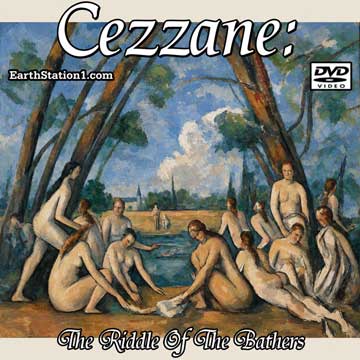
June 14: International Bath Day: -- If
you have been looking for a reason to draw yourself a bath, today
is the perfect opportunity! We all crave a long, hot soak in the
bath after a busy day. It is the easiest way to relax and a great
way to enjoy your own company. It is a very popular day for
everyone to indulge in a bath. Actually, International Bath Day is
less about enjoying a long bath and more about rewarding yourself
with the simple pleasures of self-love by doing something that's
just for yourself. It was on June 14 that the Greek mathematician,
scientist, and scholar Archimedes discovered that an object's
volume could be accurately measured by being submerged in water -
while he was in a bath! Eager to share his excitement over this
discovery, Archimedes jumped out of the bathtub and yelled
"Eureka, eureka!" as he ran through the streets of
Syracuse. While not all of us are geniuses, International Bath Day
is also an ideal day for encouraging learning and discovery in
children. Bath toys can be incorporated during bath time to teach
children about the basic workings of the universe. Today, we are
used to comfortable bathrooms with showers, tubs, and
pressure-controlled water flow. But, not very long ago, bathing
used to be quite an uncomfortable experience. For example, in 19th
century England, a bath was simply a large cold metal container
placed in front of a fireplace - without any plumbing. And, in
other parts of the world, people had to take a dip in a nearby
pond or river when they wanted to clean themselves, braving cold
weather conditions and other health hazards. Even as we enjoy
comfortable baths in temperature-controlled water, it's essential
to remember that there are many people in the world without any
access to clean and potable water. So even though it's alright to
enjoy a luxurious bath every once in a while, we must remember to
never waste water. On Sale @ 15% Off Discount Till Midnight PT!
https://store.earthstation1.com/paul-cezanne-amp-the-riddle-of-the-great-bathers-mp4-video-download-dv4.html
Today's
EarthStation1.com 15% Off Commemorative Memorial Title: In Search
Of Genghis Khan + 2 Bonus Titles DVD MP4 Download USB Drive
Today, June 14, 2026
June 14, 1285: The Mongols: Mongol
Invasions And Conquests: The Mongol Invasions Of Vietnam: The
Second Mongol Invasion Of Vietnam: The Battle Of Chuong Duong: --
Forces led by Tran Dynasty Of Vietnam Prince Tran Quang Khai
destroy most of the invading Mongol naval fleet in a battle at
Chuong Duong Port (modern-day Thuong Tin District, Hanoi)) on the
Red River. Most of the Yuan warships were burned and sunk, while
Mongol General Sogetu was killed in the battle. in The Battle Of
Chuong Duong. By 1282, Kublai Khan had become dissatisfied with
the tribute arrangement which granted his Yuan dynasty the same
amount of tribute as the former Chinese Song dynasty had, and so
demanded greater tributary payments. In 1283, Khublai Khan sent
word to the Tran Dynasty (rulers of today's North Vientam) that he
intended to send Yuan armies through Tran territory to attack the
kingdom of Champa (today's Central and South Vietnam) with demands
for provisions and other support to the Yuan army. In 1284 Kublai
appointed his son Toghan (Vietnamese: Thoat Hoan) to conquer
Champa. Toghan demanded from the Tran a route to Champa, which
would trap the Champan army from both north and south. While Thanh
Tong and Nhan Tong initially accepted the demand reluctantly, they
then ordered an attack on the Mongol army. As the Yuan forces
advanced down the Red River (today's Hong River, leading from
China to Hanoi, the capital of modern Vietnam), dispersing their
power, Tran Prime Minister Quang Khai personally launched a large
counterattack that consisted more than 100 thousand troops at the
Battle of Chuong Duong and Van Kiep, forcing Mongal commander
Toghan to withdraw. Toghan returned without a huge loss of the
army under him thanks to the Kipchak officer Sidor and his navy.
Seeing the Mongol force weakened under the Vietnamese heat and
sickness, Tran Hung Dao took this opportunity to strike, selecting
battlefields where the Mongol cavalry could not be fully employed.
The Mongol forces under Sogetu and Li Heng then suffered a major
defeat on land and water on and about the muddy grounds of the Red
River. The Yuan army retreated north, but few made it back to
China due to pursuing Dai Viet troops and fighters from the Hmong
and Yao peoples. On Sale @ 15% Off Discount Till Midnight PT!
https://store.earthstation1.com/in-search-of-genghis-khan-historic-1991-tomb-expedition-dvd-mp19914.html
Today's
EarthStation1.com 15% Off Commemorative Memorial Title: The Mongol
Hordes: Storm From The East TV Series DVD MP4 USB Drive
Today, June 14, 2026
June 14, 1287: The Mongols: The Mongol
Empire: The Royal House Of Borjigin: The Chinese Dynasties (The
Dynasties Of China, The Chinese Monarchy): The Yuan Dynasty
(Chinese: Yuanchao) (The Great Yuan): The Reign Of Kublai Khan:
Nayan's Rebellion: Mongolian Khagan Kublai Khan defeats the forces
of Mongol Prince Nayan, a Nestorian Christian of the same Borjigin
royal family Kublai belonged to, and other allied traditionalist
Borjigin princes in East Mongolia and Manchura, who launched a
noteworthy and serious rebellion against Kublai Khan. Much of what
is known of Nayan and his rebellion was recorded by the famous
Venetian traveller Marco Polo. The Borjigin (plural Borjigid),
were the the last name of the imperial clan of Genghis Khan and
his successors. The senior Borjigids provided ruling princes for
Mongolia and Inner Mongolia until the 20th century. The clan
formed the ruling class among the Mongols and some other peoples
of Central Asia and Eastern Europe. Today, the Borjigid are found
in most of Mongolia, Inner Mongolia and Xinjiang, although genetic
research has shown that descent from Genghis Khan is common in
Central Asia. On Sale @ 15% Off Discount Till Midnight PT!
https://store.earthstation1.com/the-mongol-hordes-storm-from-the-east-tv-series-dvd-mp4-usb-driv4.html
Today's
EarthStation1.com 15% Off Commemorative Memorial Title: Damn The
Defiant! H.M.S. Defiant 1962 RN Alec Guinness DVD MP4 USB
Today, June 14, 2026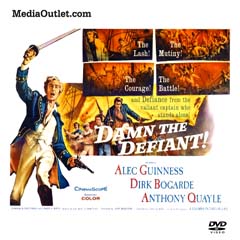
June 14, 1789: Naval History: The History
Of The Royal Navy: The Voyage Of Bounty (The Voyage Of The HMS
Bounty): Mutinies: Royal Navy Mutinies: Piracy: Acts Of Piracy:
The Mutiny On The Bounty (The Mutiny Of The HMS Bounty): The
Aftermath Of The Mutiny On The Bounty (The Aftermath Of The Mutiny
Of The HMS Bounty): Captain Bligh's Open-Boat Voyage From The HMS
Bounty: -- After an historic voyage of unparalleled seamanship and
navigation of nearly 4,600 miles (7,400 km) journey in an open
boat from where they had been cast adrift some 30 nautical miles
(35 miles, 56 km) south of the Tonga island of Tofua in the South
Pacific Ocean by the mutineers of The Mutiny On The Bounty, the
survivors of Captain Bligh's Launch Voyage From The HMS Bounty,
including Lieutenant William Bligh and 18 of the loyal crewmen who
went with him, reach the Dutch settlement of Coupang (modern
Kupang, the capital of the Indonesian province of East Nusa
Tenggara) on the island of Timor, an island at the southern end of
Maritime Southeast Asia, in the north of the Timor Sea, an island
that has since been divided between Indonesia and East Timor. The
mutiny on the Royal Navy vessel HMS Bounty occurred when
disaffected crewmen, led by acting-Lieutenant Fletcher Christian,
seized control of the ship after a three-week string of paranoid
schizophrenic, erratic and illogical behavior, largely inflicted
upon Christian. Bligh hoped to find water and food on Tofua, then
proceed to the nearby island of Tongatapu to seek help from King
Poulaho (whom he knew from his visit with Cook) in provisioning
the boat for a voyage to the Dutch East Indies. Ashore at Tofua,
there were encounters with natives who were initially friendly but
grew more menacing as time passed. On May 2, four days after
landing, Bligh realised that an attack was imminent. He directed
his men back to the sea, shortly before the Tofuans seized the
launch's stern rope and attempted to drag it ashore. Bligh coolly
shepherded the last of his shore party and their supplies into the
boat. In an attempt to free the rope from its captors, the
quartermaster John Norton leapt into the water; he was immediately
set upon and stoned to death. The launch escaped to the open sea,
where the shaken crew reconsidered their options. A visit to
Tongatapu, or any island landfall, might incur similarly violent
consequences; their best chance of salvation, Bligh reckoned, lay
in sailing directly to the Dutch settlement of Kupang in Timor,
using the rations presently on board. This was a journey of some
3,500 nautical miles (6,500 km; 4,000 mi) to the west, beyond the
Endeavour Strait, and it would necessitate daily rations of an
ounce of bread and a quarter-pint of water for each man. The plan
was unanimously agreed. From the outset, the weather was wet and
stormy, with mountainous seas that constantly threatened to
overwhelm the boat. When the sun appeared, Bligh noted in his
daily journal that it "gave us as much pleasure as a winter's
day in England". Bligh endeavoured to continue his journal
throughout the voyage, observing, sketching, and charting as they
made their way west. To keep up morale, he told stories of his
prior experiences at sea, got the men singing, and occasionally
said prayers. The launch made the first passage by Europeans
through the Fiji Islands, but they dared not stop because of the
islanders' reputation for cannibalism. On May 17, Bligh recorded
that "our situation was miserable; always wet, and suffering
extreme cold ... without the least shelter from the weather".
A week later with the skies clearing, birds began to appear,
signalling a proximity to land. On May 28, the Great Barrier Reef
was sighted; Bligh found a navigable gap and sailed the launch
into a calm lagoon. Late that afternoon, he ran the boat ashore on
a small island off the coast of northeast Australia, which he
named Restoration Island. Here, the men found oysters and berries
in plentiful supply and were able to eat ravenously. Over the next
four days, the party island-hopped northward within the lagoon,
aware that their movements were being closely monitored by natives
on the mainland. Strains were showing within the party; following
a heated disagreement with Purcell, Bligh grabbed a cutlass and
challenged the carpenter to fight. Fryer told Cole to arrest their
captain but backed down after Bligh threatened to kill him if he
interfered. On June 2, the launch cleared Cape York, the extreme
northern point of the Australian continent. Bligh turned
south-west and steered through a maze of shoals, reefs, sandbanks,
and small islands. The route taken was not the Endeavour Strait,
but a narrower southerly passage later known as the Prince of
Wales Channel. At 20:00 that evening they reached the open Arafura
Sea, still 1,100 nautical miles (2,000 km; 1,300 mi) from Kupang.
The following eight days encompassed some of the toughest travel
of the entire journey and, by June 11, many were close to
collapse. The next day, the coast of Timor was sighted: "It
is not possible for me to describe the pleasure which the blessing
of the sight of this land diffused among us", Bligh wrote. On
June 14, with a makeshift Union Jack hoisted, they sailed into
Kupang harbour. In Kupang, Bligh reported the mutiny to the
authorities, and wrote to his wife: "Know then, my own Dear
Betsey, I have lost the Bounty ..." Nelson the botanist
quickly succumbed to the harsh Kupang climate and died. On August
20, the party departed for Batavia (now called Jakarta) to await a
ship for Europe; the cook Thomas Hall died there, having been ill
for weeks. Bligh obtained passages home for himself, his clerk
Samuel, and his servant John Smith, and sailed on October 16,
1789. Four of the remainder -- the master's mate Elphinstone, the
quartermaster Peter Linkletter, the butcher Robert Lamb and the
assistant surgeon Thomas Ledward -- all died either in Batavia or
on their journeys home. Fifteen years after the Bounty mutiny, he
was appointed Governor Of New South Wales in Australia, with
orders to clean up the corrupt rum trade of the New South Wales
Corps. His actions directed against the trade resulted in the
so-called Rum Rebellion, during which Bligh was again placed under
arrest and deposed from his command. On Sale @ 15% Off Discount
Till Midnight PT!
https://store.earthstation1.com/damn-the-defiant-alec-guinness-napoleonic-british-naval-dvd.html
Today's
EarthStation1.com 15% Off Commemorative Memorial Title: Napoleon
Bonaparte Documentaries Collection MP4 Video Download DVD
Today, June 14, 2026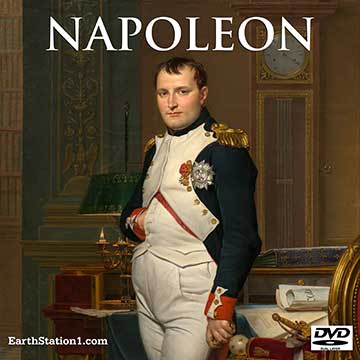
June 14, 1807: The Age Of Enlightenment
(The Enlightenment, The Age Of Reason): The Age Of Revolution: The
Atlantic Revolutions: The French Revolution: The French
Revolutionary And Napoleonic Wars (The Great French War) (The
French Revolutionary Wars, The Napoleonic Wars): The Napoleonic
Wars: The Coalition Wars: The War Of The Fourrd Coalition: The
Battle Of Friedland: -- French Emperor Napoleon's Grande Armee
ends The War Of The Fourth Coalition when it routs much of the
Russian army at Friedland, Prussia (modern Pravdinsk, Russia),
which retreated chaotically over the Alle River by the end of the
fighting, in a decisive victory against the Russian General Count
Levin August von Bennigsen's forces and one of the major
engagements of all The Napoleonic Wars. The battle began when
Bennigsen noticed the seemingly isolated reserve corps of Marshal
Lannes at the town of Friedland. Bennigsen, who planned only to
secure his march northward to Wehlau and never intended to risk an
engagement against Napoleon's numerically-superior forces, thought
he had a good chance of destroying these isolated French units
before Napoleon could save them, and ordered his entire army over
the Alle River. Lannes skillfully held his ground against
determined Russian attacks until Napoleon could bring additional
forces onto the field. Bennigsen could have recalled the Russian
forces, numbering about 50,000-60,000 men on the opposite bank of
the river, and retreated across the river before the arrival of
Napoleon's entire army but, being in poor health, decided to stay
at Friedland and took no measures to protect his exposed and
exhausted army. By late afternoon, the French had amassed a force
of 80,000 troops close to the battlefield. Relying on superior
numbers and the vulnerability of the Russians with their backs to
the river, Napoleon concluded that the moment had come and ordered
a massive assault against the Russian left flank. The sustained
French attack pushed back the Russian army and pressed them
against the river behind. Unable to withstand the pressure, the
Russians broke and started escaping across the Alle, where an
unknown number of them died from drowning. The Russian army
suffered horrific casualties at Friedland-losing over 40% of its
soldiers on the battlefield. Napoleon's overwhelming victory was
enough to convince the Russian political establishment that peace
was necessary. Friedland effectively ended the War Of The Fourth
Coalition, as Emperor Alexander I reluctantly entered peace
negotiations with Napoleon. These discussions eventually
culminated in the Treaties of Tilsit, by which Russia agreed to
join the Continental System against Great Britain and by which
Prussia lost almost half of its territories. The lands lost by
Prussia were converted into the new Kingdom of Westphalia, which
was governed by Napoleon's brother, Jerome. Tilsit also gave
France control of the Ionian Islands, a vital and strategic entry
point into the Mediterranean Sea. Some historians regard the
political settlements at Tilsit as the height of Napoleon's empire
because there was no longer any continental power challenging the
French domination of Europe. The War Of The Fourth Coalition was
fought against Napoleon's French Empire, and the Fourth Coalition
were defeated in a war spanning 1806-1807. The main coalition
partners were Prussia and Russia with Saxony, Sweden, and Great
Britain also contributing. Excluding Prussia, some members of the
coalition had previously been fighting France as part of the Third
Coalition, and there was no intervening period of general peace.
On 9 October 1806, Prussia joined a renewed coalition, fearing the
rise in French power after the defeat of Austria and establishment
of the French-sponsored Confederation of the Rhine. Prussia and
Russia mobilized for a fresh campaign with Prussia massing troops
in Saxony. Napoleon decisively defeated the Prussians in an
expeditious campaign that culminated at the Battle of
Jena-Auerstedt on 14 October 1806. French forces under Napoleon
occupied Prussia, pursued the remnants of the shattered Prussian
Army, and captured Berlin. They then advanced all the way to East
Prussia, Poland and the Russian frontier, where they fought an
inconclusive battle against the Russians at the Battle of Eylau on
7-8 February 1807. Napoleon's advance on the Russian frontier was
briefly checked during the spring as he revitalized his army with
fresh supplies. Russian forces were finally crushed by the French
at the Battle of Friedland on 14 June 1807, and three days later
Russia asked for a truce. Through the Treaties of Tilsit in July
1807, France made peace with Russia, which agreed to join the
Continental System. The treaty was particularly harsh on Prussia,
however, as Napoleon demanded much of the Prussian territory along
the lower Rhine west of the Elbe and in what was part of the
former Polish-Lithuanian Commonwealth. Respectively, these
acquisitions were incorporated into the new Kingdom of Westphalia,
led by his brother Jerome Bonaparte. He also established the Duchy
of Warsaw, a Polish client state, ruled by his new ally the king
of Saxony. At the end of the war Napoleon was master of almost all
of western and central continental Europe, except for Spain,
Portugal, Austria and several other smaller states. Despite the
end of the Fourth Coalition, Britain remained at war with France.
Hostilities on land resumed later in 1807, when a Franco-Spanish
force invaded Britain's ally Portugal, beginning the Peninsular
War. A further Fifth Coalition would be assembled when Austria
re-joined the conflict in 1809. On Sale @ 15% Off Discount Till
Midnight PT!
https://store.earthstation1.com/napoleon-bonaparte-documentaries-collection-mp4-video-download-dv4.html
Today's
EarthStation1.com 15% Off Commemorative Memorial Title: Ethnic
Notions + The Mammy Legend: Black Stereotypes DVD MP3 USB Drive
Today, June 14, 2026
June 14, 1811: #BOTD: #HBD! Harriet
Beecher Stowe, American abolitionist, author and activist (d. July
1, 1896) is #born Harriet Elisabeth Beecher Stowe in Litchfield,
Connecticut. On June 5, 1851, her anti-slavery serial, Uncle Tom's
Cabin, or Life Among the Lowly, started a ten-month run in the
National Era abolitionist newspaper. It was published as a book in
1852, and the novel helped lay the groundwork for the Civil War.
Stowe, a Connecticut-born teacher at the Hartford Female Seminary
and an active abolitionist, featured the character of Uncle Tom, a
long-suffering black slave around whom the stories of other
characters revolve. The sentimental novel depicts the reality of
slavery while also asserting that Christian love can overcome
something as destructive as enslavement of fellow human beings.
Uncle Tom's Cabin was the best-selling novel of the 19th century
and the second best-selling book of that century, following the
Bible. It is credited with helping fuel the abolitionist cause in
the 1850s. In the first year after it was published, 300,000
copies of the book were sold in the United States; one million
copies in Great Britain. In 1855, three years after it was
published, it was called "the most popular novel of our day."
The impact attributed to the book is great, reinforced by a story
that when Abraham Lincoln met Stowe at the start of the Civil War,
Lincoln declared, "So this is the little lady who started
this great war." The quote is apocryphal; it did not appear
in print until 1896. The book and the plays it inspired helped
popularize a number of stereotypes about black people. These
include the affectionate, dark-skinned "mammy"; the
"pickaninny" stereotype of black children; and the
"Uncle Tom", or dutiful, long-suffering servant faithful
to his white master or mistress. In recent years, the negative
associations with Uncle Tom's Cabin have, to an extent,
overshadowed the historical impact of the book as a "vital
antislavery tool." Harriet Beecher Stowe died in Hartford,
Connecticut, 17 days after her 85th birthday. She is buried in the
historic cemetery at Phillips Academy in Andover, Massachusetts,
along with her husband and their son Henry Ellis. On Sale @ 15%
Off Discount Till Midnight PT!
https://store.earthstation1.com/ethnic-notions-africanamerican-stereotypes-dvd.html
Today's
EarthStation1.com 15% Off Commemorative Memorial Title: War
Reporters: Armed Conflict News Reporters DVD, Download, USB Drive
Today, June 14, 2026
June 14, 1906: #BOTD: #HBD! Margaret
Bourke-White, American photographer, photojournalist and
documentary photographer, war reporter and photographer during
World War II and The Korean War, best known as the first foreign
photographer permitted to take pictures of Soviet industry under
the Soviets' first five-year plan, as the first American female
war photojournalist, and for taking the photograph of the
construction of Fort Peck Dam that became the cover of the first
issue of Life magazine (d. August 27, 1971) is #born Margaret
White in the Bronx, New York, the daughter of Joseph White, a
non-practicing Jew whose father came from Poland, and Minnie
Bourke, who was of Irish Catholic descent. In 1936, Margaret
Bourke-White became one of four original staff photographers for
Life Magazine. She was the first woman to become an accredited war
correspondent during World War II. She covered the Italian
campaign, the siege of Moscow and the American crossing of the
Rhine into Germany. Her photographs of Nazi concentration camps
stunned the world. She later photographed Mahatma Gandhi and
covered the migration of millions of people after the Indian
subcontinent was subdivided. She also served as a war
correspondent during the Korean War. Her best known book was a
study of rural poverty in the American South, You Have Seen Their
Faces (1937). Margaret Bourke-White died at Stamford Hospital in
Stamford, Connecticut aged 67 of Parkinson's Disease about
eighteen years after developing symptoms. Her remains were
cremated; the location of her ashes is not publicly disclosed. On
Sale @ 15% Off Discount Till Midnight PT!
https://store.earthstation1.com/war-reporters-dvd-news-correspondents-covering-armed-conflict.html
Today's
EarthStation1.com 15% Off Commemorative Memorial Title: The Old
Time Radio Music MP3 MegaSet DVD, Audio Download, USB Stick
Today, June 14, 2026
June 14, 1909: #BOTD: #HBD! Burl Ives,
American singer and actor of stage, screen, radio and television
(d. April 14, 1995) is #born Burl Icle Ivanhoe Ives in Hunt City,
an unincorporated town in Jasper County, Illinois. Ives began as
an itinerant singer and banjoist, and launched his own radio show,
The Wayfaring Stranger, which popularized traditional folk songs.
In 1942, he appeared in Irving Berlin's This Is the Army, and then
became a major star of CBS radio. In the 1960s, he successfully
crossed over into country music, recording hits such as "A
Little Bitty Tear" and "Funny Way of Laughin'". A
popular film actor through the late 1940s and '50s, Ives's
best-known film roles included parts in So Dear to My Heart (1949)
and Cat on a Hot Tin Roof (1958), as well as Rufus Hannassey in
The Big Country (1958), for which he won an Academy Award for Best
Supporting Actor. Ives is often remembered for his voice-over work
as Sam the Snowman, narrator of the classic 1964 Christmas
television special Rudolph the Red-Nosed Reindeer, which continues
to air annually around Christmas. Burl Ives died of oral cancer at
his home in Anacortes, Washington at the age of 85. He is buried
at Mound Cemetery in Hunt City Township, Jasper County, Illinois.
On Sale @ 15% Off Discount Till Midnight PT!
https://store.earthstation1.com/the-old-time-radio-music-megaset-dual-layer-mp3-dv3.html
Today's
EarthStation1.com 15% Off Commemorative Memorial Title: Portraits
Of The Presidency: POTUS Documentaries DVD, Download, USB
Today, June 14, 2026
June 14, 1922: The History Of
Broadcasting: The History Of Radio Broadcasting: -- Warren G.
Harding became the first U.S. President to broadcast a message
over the radio. The event was the dedication of the Francis Scott
Key Memorial in Baltimore. Harding was the first president to own
a radio, and the first to have one inside the White House. The
broadcast marked a fundamental change in how presidents addressed
and communicated with the American people, greatly increasing the
speed and range of such communications. On Sale @ 15% Off Discount
Till Midnight PT!
https://store.earthstation1.com/portraits-of-the-presidency-roosevelt-wilson-hoover-taft-willkie.html
Today's
EarthStation1.com 15% Off Commemorative Memorial Title: CIA The
Secret Files The Central Intelligence Agency TV Series MP4 DVD
Today, June 14, 2026
June 14, 1928: #BOTD: Che Guevara,
nicknamed "Che", Argentine Marxist revolutionary,
physician, author, guerrilla leader, diplomat, and military
theorist, a major figure of the Cuban Revolution, whose stylized
visage has become a ubiquitous countercultural symbol of rebellion
and global insignia in popular culture (d. October 9, 1967) is
#born Ernesto Guevara in Rosario, Santa Fe, Argentina. He earned
his nickname "Che" from his frequent use of the
expression - an expression used in Spanish-speaking countries
which translates as "hey mate!" or "hey buddy!"
in English - which amused his Cuban comrades, rendering his name
in English roughly as "Buddy Guevara" or "Hey Buddy
Guevara". As a young medical student, Guevara traveled
throughout South America and was radicalized by the poverty,
hunger and disease he witnessed. His burgeoning desire to help
overturn what he saw as the capitalist exploitation of Latin
America by the United States prompted his involvement in
Guatemala's social reforms under President Jacobo Arbenz, whose
eventual CIA-assisted overthrow at the behest of the United Fruit
Company solidified Guevara's political ideology. Later in Mexico
City, Guevara met Raul and Fidel Castro, joined their 26th of July
Movement and sailed to Cuba aboard the yacht Granma with the
intention of overthrowing U.S.-backed Cuban dictator Fulgencio
Batista. Guevara soon rose to prominence among the insurgents, was
promoted to second in command and played a pivotal role in the
victorious two-year guerrilla campaign that deposed the Batista
regime. Following the Cuban Revolution, Guevara performed a number
of key roles in the new government. These included reviewing the
appeals and firing squads for those convicted as war criminals
during the revolutionary tribunals, instituting agrarian land
reform as minister of industries, helping spearhead a successful
nationwide literacy campaign, serving as both national bank
president and instructional director for Cuba's armed forces, and
traversing the globe as a diplomat on behalf of Cuban socialism.
Such positions also allowed him to play a central role in training
the militia forces who repelled the Bay Of Pigs Invasion, and
bringing Soviet nuclear-armed ballistic missiles to Cuba, which
precipitated the 1962 Cuban Missile Crisis. Additionally, Guevara
was a prolific writer and diarist, composing a seminal manual on
guerrilla warfare, along with a best-selling memoir about his
youthful continental motorcycle journey. His experiences and
studying of Marxism-Leninism led him to posit that the Third
World's underdevelopment and dependence was an intrinsic result of
imperialism, neocolonialism and monopoly capitalism, with the only
remedy being proletarian internationalism and world revolution.
Guevara left Cuba in 1965 to foment revolution abroad, first
unsuccessfully in Congo-Kinshasa and later in Bolivia, where he
was captured by CIA-assisted Bolivian forces and summarily
executed. Guevara remains both a revered and reviled historical
figure, polarized in the collective imagination in a multitude of
biographies, memoirs, essays, documentaries, songs, and films. As
a result of his perceived martyrdom, poetic invocations for class
struggle and desire to create the consciousness of a "new
man" driven by moral rather than material incentives, Guevara
has evolved into a quintessential icon of various leftist
movements. Time magazine named him one of the 100 most influential
people of the 20th century, while an Alberto Korda photograph of
him, titled Guerrillero Heroico (shown), was cited by the Maryland
Institute College of Art as "the most famous photograph in
the world". Che Guevara dies by execution for attempting to
incite that revolution, one day after he and his men were captured
in Bolivia while they were attempting to incite a revolution
there. His hands were cut off and sent to the CIA agent in charge
of the clandestine operation that tracked down and organized his
capture and execution. The Che Guevara Mausoleum (Spanish:
Mausoleo Del Che Guevara, officially Conjunto Escultorico Memorial
Comandante Ernesto Che Guevara), a memorial in Santa Clara, Cuba,
located in "Plaza Che Guevara" (Che Guevara Square),
houses his remains of the revolutionary Ernesto "Che"
Guevara and 29 fellow combatants killed along with him. On Sale @
15% Off Discount Till Midnight PT!
https://store.earthstation1.com/cia-the-secret-files-the-central-intelligence-agency-tv-series-mp4-dv4.html
Today's
EarthStation1.com 15% Off Commemorative Memorial Title: The Golden
Age Of Rock 'N' Roll DVD, MP4 Video Download, Flash Drive
Today, June 14, 2026
June 14, 1931: #BOTD: #HBD! Junior
Walker, African American singer and saxophonist who recorded for
Motown during the 1960s (June 14, 1931 - November 23, 1995) is
#born Autry DeWalt Mixon Jr. in Blytheville, Arkansas, and grew up
in South Bend, Indiana. He began playing saxophone while in high
school, and his saxophone style was the anchor for the sound of
the bands he later played in. His career started when he developed
his own band in the mid-1950s as the Jumping Jacks. His longtime
friend and drummer Billy Nicks (1935-2017) formed his own group,
the Rhythm Rockers. Periodically, Nicks would sit in on Jumping
Jack's shows, and Walker would sit in on the Rhythm Rockers shows.
Nicks obtained a permanent gig at a local TV station in South
Bend, Indiana, and asked Walker to join him and keyboard player
Fred Patton permanently. Nicks asked Willie Woods (1936-1997), a
local singer, to perform with the group; Woods would learn how to
play guitar. When Nicks was drafted into the United States Army,
Walker convinced the band to move from South Bend to Battle Creek,
Michigan. While performing in Benton Harbor, Walker found a
drummer, Tony Washington, to replace Nicks.Eventually, Fred Patton
left the group, and Victor Thomas stepped in. The original name,
The Rhythm Rockers, was changed to "The All Stars."
Walker's style was inspired by jump blues and early R & B,
particularly players like Louis Jordan, Earl Bostic, and Illinois
Jacquet. The group was spotted by Johnny Bristol, and in 1961 he
recommended them to Harvey Fuqua, who had his own record labels.
Once the group started recording on the Harvey label, their name
was changed to Jr. Walker All Stars. The name was modified again
when Fuqua's labels were taken over by Motown's Berry Gordy, and
Jr. Walker & the All Stars became members of the Motown
family, recording for their Soul imprint in 1964. The members of
the band changed after the acquisition of the Harvey label. Tony
Washington, the drummer, quit the group, and James Graves joined.
Their first and signature hit was "Shotgun", written and
composed by Walker and produced by Berry Gordy, which featured the
Funk Brothers' James Jamerson on bass and Benny Benjamin on drums.
"Shotgun" reached No. 4 on the Billboard Hot 100 and No.
1 on the R & B chart in 1965, and was followed by many other
hits, such as "(I'm a) Road Runner", "Shake and
Fingerpop" and remakes of two Motown songs "Come See
About Me" and "How Sweet It Is (To Be Loved by You)",
that had previously been hits for the Supremes and Marvin Gaye
respectively. In 1966, Graves left and was replaced by old cohort
Billy "Stix" Nicks, and Walker's hits continued apace
with tunes such as "I'm a Road Runner" and "Pucker
Up Buttercup". In 1969, the group had another hit enter the
top 5, "What Does It Take (To Win Your Love)". A Motown
quality control meeting rejected this song for single release, but
radio station DJs made the track popular, resulting in Motown
releasing it as a single, whereupon it reached No. 4 on the Hot
100 and No. 1 on the R & B chart. From that time on, Walker
sang more on the records than earlier in their career. He landed
several more R & B Top Ten hits over the next few years, with
the last coming in 1972. He toured the UK in 1970 with drummer
Jerome Teasley (Wilson Pickett), guitarist Phil Wright (brother of
Betty "Clean Up Woman" Wright), keyboardist Sonny Holley
(The Temptations) and brilliant young Liverpool UK bassist Norm
Bellis (Apple). The band played two venues on each of the 14
nights. The finale was at The Valbonne in London's West End. They
were joined on stage by The Four Tops for an impromptu set. In
1979, Walker went solo, disbanding the All Stars, and was signed
to Norman Whitfield's Whitfield Records label, but he was not as
successful on his own as he had been with the All Stars in his
Motown period. Walker re-formed the All Stars in the 1980s. On
April 11, 1981, Walker was the musical guest on the season finale
of Saturday Night Live. Foreigner's 1981 album 4 featured Walker's
sax solo on "Urgent". He later recorded his own version
of the song for the 1983 All Stars's album Blow the House Down.
Walker's version was also featured in the 1985 Madonna film
Desperately Seeking Susan. In 1983, Walker was re-signed with
Motown. In the same year, he appeared as a part of the Motown 25
television special which aired on May 16, 1983. In 1988, Walker
played opposite Sam Moore as one-half of the fictional soul duo
The Swanky Modes in the comedy Tapeheads. Several songs were
recorded for the soundtrack, including "Bet Your Bottom
Dollar" and "Ordinary Man", produced by ex-Blondie
member Nigel Harrison. Junior Walker died of cancer on November
23, 1995 at the age of 64, in Battle Creek, Michigan. He had been
inducted into the Rhythm and Blues Foundation that year. He is
buried in Oak Hill Cemetery, in Battle Creek, Michigan, under a
marker inscribed with both his birth name of Autry DeWalt Mixon
Jr. and his stage name. Walker also performed as a session and
live-performing saxophonist with the band Foreigner during the
1980s. Walker's "Shotgun" was inducted into the Grammy
Hall of Fame in 2002. Jr. Walker & The All Stars were voted
into the Michigan Rock and Roll Legends Hall of Fame in 2007. On
Sale @ 15% Off Discount Till Midnight PT!
https://store.earthstation1.com/the-golden-age-of-rock-39n39-roll-dvd-complete-tv-series-5-39395.html
Today's
EarthStation1.com 15% Off Commemorative Memorial Title: Jerzy
Kosinski: Interview Biography DVD, Video Download, USB Drive
Today, June 14, 2026
June 14, 1933: #BOTD: #HBD! Jerzy
Kosinski, Polish-American novelist and screenwriter (d. May 3,
1991) is #born Jozef Lewinkopf to Jewish parents in Lodz, Poland.
He was a two-time President of the American Chapter of P.E.N. (a
worldwide association of writers, founded in London in 1921 to
promote friendship and intellectual co-operation among writers
everywhere) who wrote primarily in English. Born in Poland, he
survived World War II and, as a young man, immigrated to the U.S.,
where he became a citizen. He was known for various novels, among
them The Painted Bird (1965), a book about life during the
Holocaust, and Being There (1970), the latter of which was adapted
as a film (1979). In June 1982, a Village Voice report by Geoffrey
Stokes and Eliot Fremont-Smith accused Kosinski of plagiarism,
claiming that much of his work was derivative of prewar books
unfamiliar to English readers, and that Being There was a
plagiarism of Kariera Nikodema Dyzmy - The Career of Nicodemus
Dyzma - a 1932 Polish bestseller by Tadeusz Dolega-Mostowicz. They
also alleged Kosinski wrote The Painted Bird in Polish, and had it
secretly translated into English. The report claimed that
Kosinski's books had actually been ghost-written by "assistant
editors", finding stylistic differences among Kosinski's
novels. Kosinski, according to them, had depended upon his
free-lance editors for "the sort of composition that we
usually call writing." American biographer James Sloan notes
that New York poet, publisher and translator, George Reavey,
claimed to have written The Painted Bird for Kosinski. Kosinski
suffered from multiple illnesses towards the end of his life, and
he continued to be under attack from journalists who accused him
of plagiarism. By his late 50s, he was suffering from an irregular
heartbeat, as well as severe physical and nervous exhaustion. He
committed suicide on May 3, 1991, by ingesting a lethal amount of
alcohol and drugs and wrapping a plastic bag around his head,
suffocating to death. His suicide note read: "I am going to
put myself to sleep now for a bit longer than usual. Call it
Eternity." His remains were cremated, and his ashes were
scattered off a small cove in Casa de Campo in the Dominican
Republic. On Sale @ 15% Off Discount Till Midnight PT!
https://store.earthstation1.com/jerzy-kosinski-dvd-novelist-interview.html
Today's
EarthStation1.com 15% Off Commemorative Memorial Title: TV Music &
Dance Shows #8 American Action DVD, MP4, USB Flash Drive
Today, June 14, 2026
June 14, 1936: #BOTD: #HBD! Obie Benson,
African American soul and R & B singer and songwriter of The
Four Tops, best known as a founding member and the bass singer of
Motown group the Four Tops, which he joined in 1953 and continued
to perform with for over five decades (d. July 1, 2005) is #born
Renaldo Benson in Detroit, Michigan. He co-wrote "What's
Going On", which became a No. 2 hit for Marvin Gaye in 1971,
and which Rolling Stone rated as No. 4 on their List of Rolling
Stone's 500 Greatest Songs of All Time released in 2004. Obie
Benson died of lung cancer and other illnesses, aged 69. He is
interred at Woodlawn Cemetery. Media coverage of Benson's death
was almost completely overshadowed by that of another R & B
star, Luther Vandross, who also died on the same day. On Sale @
15% Off Discount Till Midnight PT!
https://store.earthstation1.com/classic-tv-music-amp-dance-shows-8-where-american-action-is-dv8.html
Today's
EarthStation1.com 15% Off Commemorative Memorial Title: Paris: The
Outraged City Cities At War WWII France DVD, MP4, USB Drive
Today, June 14, 2026
June 14, 1940: The European Civil War:
World War II: The Second European War (The European Theater Of
World War II): The Battle Of France (The Western Campaign [German:
Westfeldzug], The French Campaign [German: Frankreichfeldzug;
French: Campagne De France], The Fall Of France): Fall Rot
(German: "Case Red"): The German Invasion Of Paris: The
German Occupation Of Paris: The Fall Of Paris: -- The German
Invasion Of Paris results in The German Occupation Of Paris as the
French capitol of Paris, which the French government in Tours
declared an open city on June 10, falls to the Nazi invaders at
5:30 in the morning as the first German advance guard enters the
city at Porte de La Villette and took the rue de Flandres toward
the center; they were followed by several German columns, which,
following an established plan, moved to the principal
intersections. The British General Staff had urged the French to
defend Paris street-by-street, but French Deputy Prime Minister
and First World War hero General Philippe Petain dismissed the
idea, stating "To make Paris into a city of ruins will not
affect the issue." German military vehicles with loudspeakers
circulated, instructing Parisians not to leave their buildings. At
eight in the morning, delegations of German officers arrived at
The Invalides, headquarters of the military governor of Paris,
Henri Dentz, and at The Prefecture Of Police, where the Prefect,
Roger Langeron, was waiting. The Germans politely invited the
French officials to put themselves at the disposition of the
German occupiers. By the end of the afternoon, the Germans had
hung a swastika flag at The Arc De Triomphe and organized military
parades with a marching band on the Champs Elysees and Avenue
Foch, primarily for the benefit of the German army photographers
and newsreel cameramen. Those Parisians who stayed in the city
found that in most cases the Germans were careful to be well
mannered; it took some months before the German occupation became
progressively more severe. After the French government had
declared Paris an open city, the German 18th Army deployed against
Paris. The French resisted the approaches to the capital strongly,
but the line was broken in several places. French Supreme Military
Commander General Weygand reacted by asserted that it would now
not take long for the French Army to disintegrate. On June 13,
Churchill attended a meeting of the Anglo-French Supreme War
Council at Tours. He suggested a Franco-British Union, which the
French rejected. Fall Rot (Case Red) was the plan for the second
phase of the conquest of France by the German Army and began on
June 5, 1940. It had been made possible by the success of Fall
Gelb (Case Yellow), the invasion of the Benelux countries and
northern France in the Battle Of France and the encirclement of
the Allied armies in the north on the Channel coast. Powerful
forces were also to advance into France. Fall Rot consisted of two
sub-operations: 1) the preliminary attack in the west that began
on June 5 over the river Somme in the direction of the Seine, and
2) the main offensive by Army Group A started on June 9 in the
centre over the river Aisne. Fall Rot concluded with the German
victory in The Battle Of The Maginot Line (1940), when the German
XIX Korps reached the Swiss border and the Maginot defences were
cut off from France. On Sale @ 15% Off Discount Till Midnight PT!
https://store.earthstation1.com/paris-the-outraged-city-dvd-cities-at-war-wwii-france.html
Today's
EarthStation1.com 15% Off Commemorative Memorial Title: Auschwitz
And The Allies 2 Part TV Series DVD, Download, USB Drive
Today, June 14, 2026
June 14, 1940: The European Civil War:
World War II: The Second European War (The European Theater Of
World War II): The Holocaust (Shoah): The Holocaust In Poland:
Auschwitz Concentration Camp (KL Auschwitz, KZ Auschwitz): -- A
group of 728 Polish political prisoners from Tarnow become the
first inmates of the Auschwitz concentration camp. Auschwitz
concentration camp was a network of concentration and
extermination camps built and operated by Nazi Germany in occupied
Poland during World War II. It consisted of Auschwitz I (the
original concentration camp), Auschwitz II-Birkenau (a combination
concentration/extermination camp), Auschwitz III-Monowitz (a labor
camp to staff an IG Farben factory), and 45 satellite camps.
Auschwitz I was first constructed to hold Polish political
prisoners, who began to arrive in May 1940. The first
extermination of prisoners took place in September 1941. Auschwitz
II-Birkenau went on to become a major site of the Nazis' Final
Solution to the Jewish Question during the Holocaust. From early
1942 until late 1944, transport trains delivered Jews to the
camp's gas chambers from all over German-occupied Europe, where
they were killed en masse with the cyanide-based poison Zyklon B,
originally developed to be used as a pesticide. An estimated 1.3
million people were sent to the camp, of whom at least 1.1 million
died. Around 90 percent of those were Jews; approximately one in
six Jews killed in the Holocaust died at the camp. Others deported
to Auschwitz included 150,000 Poles, 23,000 Romani and Sinti,
15,000 Soviet prisoners of war, 400 Jehovah's Witnesses, and tens
of thousands of others of diverse nationalities, including an
unknown number of homosexuals. Many of those not killed in the gas
chambers died of starvation, forced labor, infectious diseases,
individual executions, and medical experiments. In the course of
the war, the camp was staffed by 7,000 members of the German
Schutzstaffel (SS), approximately 12 percent of whom were later
convicted of war crimes. Some, including camp commandant Rudolf
Hoss, were executed. The Allied Powers did not act on early
reports of atrocities at the camp, and their failure to bomb the
camp or its railways remains controversial. At least 802 prisoners
attempted to escape from Auschwitz, 144 successfully, and on 7
October 1944 two Sonderkommando units - prisoners assigned to
staff the gas chambers - launched a brief, unsuccessful uprising.
As Soviet troops approached Auschwitz in January 1945, most of its
population was sent west on a death march. The prisoners remaining
at the camp were liberated on 27 January 1945, a day now
commemorated as International Holocaust Remembrance Day. In the
following decades, survivors such as Primo Levi, Viktor Frankl,
and Elie Wiesel wrote memoirs of their experiences in Auschwitz,
and the camp became a dominant symbol of the Holocaust. In 1947
Poland founded the Auschwitz-Birkenau State Museum on the site of
Auschwitz I and II, and in 1979 it was named a World Heritage Site
by UNESCO. On Sale @ 15% Off Discount Till Midnight PT!
https://store.earthstation1.com/auschwitz-and-the-allies-dvd-complete-2-part-tv-serie2.html
Today's
EarthStation1.com 15% Off Commemorative Memorial Title: Pursuit To
The Rhine The Liberation Of Western Europe MP4 Download DVD
Today, June 14, 2026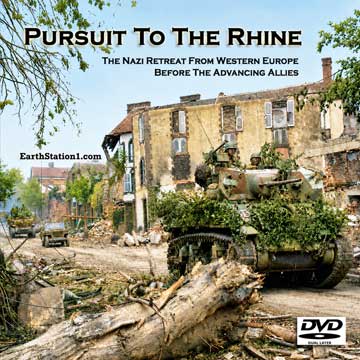
June 14, 1944: The European Civil War:
World War II: The Second European War (The European Theater Of
World War II): The Western Front Of World War II: Operation
Overlord (The Battle Of Normandy): D-Day (The D-Day Landings, The
Normandy Landings): The Battle For Caen: Operation Perch: -- After
several failed attempts, the British Army abandons Operation
Perch, the British offensive during the early stages of The Battle
Of Normandy that was intended to encircle and seize the German
occupied city of Caen, a D-Day objective for the British 3rd
Infantry Division in the early phases of Operation Overlord.
Operation Perch was to begin immediately after the British beach
landings with an advance to the south-east of Caen by XXX Corps.
Three days after the invasion the city was still in German hands
and the operation was amended. The operation was expanded to
include I Corps for a pincer attack on Caen. On the next day, XXX
Corps in the west pushed south to Tilly-sur-Seulles, which was
occupied by the Panzer-Lehr Division; the village was captured and
re-captured several times. I Corps began the eastern thrust two
days later from the Orne bridgehead, which had been secured in
Operation Tonga on D-Day. I Corps was also delayed by constant
counter-attacks of the 21st Panzer Division. With mounting
casualties and no sign of a German collapse, the offensive east of
Caen was suspended on June 13. Further west in the US First Army
area, American attacks forced a gap in the German defences. Part
of the 7th Armoured Division was diverted from Tilly-sur-Seulles,
to advance through the gap in a flanking manoeuvre and force the
Panzer Lehr Division to fall back, to avoid encirclement. On 14
June, after two days of battle including the Battle of
Villers-Bocage, the 7th Armoured Division was ordered to withdraw
towards Caumont. Plans were made to resume the offensive once the
7th Armoured Division had been reinforced but the plans came to
nothing when a storm in the English Channel seriously delayed the
landing of supplies and reinforcements. The battle is
controversial because many historians and writers have concluded
that it was failures by British divisional and corps commanders
that squandered an opportunity to capture Caen, rather than the
Germans achieving a defensive success. To resist the offensive,
the Germans had committed their most powerful armoured reserves,
which deprived them of the fighting power for a counter-offensive
and forfeited the initiative to the Allies. On Sale @ 15% Off
Discount Till Midnight PT!
https://store.earthstation1.com/pursuit-to-the-rhine-the-liberation-of-western-europe-mp4-download-dv4.html
Today's
EarthStation1.com 15% Off Commemorative Memorial Title: Art
Documentaries And Films DVD MP4 Video Download USB Flash Drive
Today, June 14, 2026
June 14, 1945: #BOTD: #HBD! Rod Argent,
English singer-songwriter, composer, record producer and keyboard
player who came to prominence in the mid 1960s as the founder and
keyboardist of the English rock band The Zombies, is #born Rodney
Terence Argent in St Albans, Hertfordshire, Southern England. In a
career spanning more than 50 years, Argent became one of the main
composers of the Zombies' music and made major lyrical
contributions to the band's songs. As the band's keyboardist he
used a variety of instruments, including Hohner Pianet, Mellotron,
harpsichord, and organ. In addition to his work with the Zombies
and Argent, Argent has made music for television series, been a
session musician, produced albums by other artists, and had a solo
career which has included three studio albums: Moving Home, Red
House, and Classically Speaking. Argent was inducted into the Rock
and Roll Hall of Fame as a member of the Zombies in Brooklyn in
March 2019. The Zombies scored British and American hits in 1964
with "She's Not There", an in the US two further hit
singles, "Tell Her No" in 1965 and "Time of the
Season" in 1968. Argent went on to form the band Argent after
the first break-up of The Zombies, who are best known for their
hit song "Hold Your Head Up"; his Hammond B3 organ solo
on that track is cited by Rick Wakeman as the greatest organ solo
ever. On Sale @ 15% Off Discount Till Midnight PT!
https://store.earthstation1.com/art-documentaries-and-films-dvd-mp4-video-download-usb-flash-driv4.html
Today's
EarthStation1.com 15% Off Commemorative Memorial Title: Songs Of
Protest And Conscience Played In The USA DVD, MP4, USB Drive
Today, June 14, 2026
June 14, 1946: #BOTD: -- Donald Trump,
American businessman, television personality, 45th and 47th
President of the United States, convicted felon and demagogue is
#born Donald John Trump at Jamaica Hospital in Queens, New York
City. Trump received a Bachelor of Science in economics from the
University of Pennsylvania in 1968. His father named him president
of his real estate business in 1971. Trump renamed it the Trump
Organization and reoriented the company toward building and
renovating skyscrapers, hotels, casinos, and golf courses. After a
series of business failures in the late twentieth century, he
launched successful side ventures, mostly licensing the Trump
name. From 2004 to 2015, he co-produced and hosted the reality
television series The Apprentice. He and his businesses have been
plaintiffs or defendants in more than 4,000 legal actions,
including six business bankruptcies. Trump won the 2016
presidential election as the Republican Party nominee against
Democratic Party nominee Hillary Clinton while losing the popular
vote. A special counsel investigation established that Russia had
interfered in the election to favor Trump. During the campaign,
his political positions were described as populist, protectionist,
isolationist, and nationalist. His election and policies sparked
numerous protests. He was the only U.S. president without prior
military or government experience. Trump promoted conspiracy
theories and made many false and misleading statements during his
campaigns and presidency, to a degree unprecedented in American
politics. Many of his comments and actions have been characterized
as racially charged, racist, and misogynistic. As president, Trump
ordered a travel ban on citizens from several Muslim-majority
countries, diverted military funding toward building a wall on the
U.S.-Mexico border, and implemented a family separation policy. He
weakened environmental protections, rolling back more than 100
environmental policies and regulations. He signed the Tax Cuts and
Jobs Act of 2017, which cut taxes and eliminated the individual
health insurance mandate penalty of the Affordable Care Act. He
appointed Neil Gorsuch, Brett Kavanaugh, and Amy Coney Barrett to
the U.S. Supreme Court. He reacted slowly to the COVID-19
pandemic, ignored or contradicted many recommendations from health
officials, used political pressure to interfere with testing
efforts, and spread misinformation about unproven treatments.
Trump initiated a trade war with China and withdrew the U.S. from
the proposed Trans-Pacific Partnership trade agreement, the Paris
Agreement on climate change, and the Iran nuclear deal. He met
with North Korean leader Kim Jong Un three times but made no
progress on denuclearization. Trump is the only U.S. president to
have been impeached twice, in 2019-20 for abuse of power and
obstruction of Congress after he pressured Ukraine to investigate
Joe Biden, and in 2021 for incitement of insurrection. The Senate
acquitted him in both cases. Trump refused to concede after he
lost the 2020 presidential election to Biden, falsely claiming
widespread electoral fraud, and attempted to overturn the results.
On January 6, 2021, he urged his supporters to march to the U.S.
Capitol, which many of them attacked. Scholars and historians rank
Trump as one of the worst presidents in American history. Since
leaving office, Trump has continued to dominate the Republican
Party and is its presumptive nominee for the 2024 presidential
election. In May 2024, a jury in New York found Trump guilty on 34
felony counts of falsifying business records related to a
hush-money payment to Stormy Daniels, making Trump the first
former U.S. president to be convicted of a crime. He has been
indicted in three other jurisdictions on 54 other felony counts
related to his mishandling of classified documents and efforts to
overturn the 2020 presidential election. In civil proceedings,
Trump was found liable for sexual abuse and defamation in 2023 and
for financial fraud in 2024. Trump began his second term upon his
inauguration on January 20, 2025. He became the oldest to assume
the presidency, the first president with a felony conviction, and
the second person to serve two nonconsecutive terms as president.
For his second administration, Trump chose several authors of
Project 2025, a political initiative published in April 2023 by
the Heritage Foundation with the goal of reshaping the U.S.
federal government by consolidating executive power in favor of
right-wing policies; after the first year of his second term about
half of the project's agenda had been implemented. Emphasizing his
conflicts with judicial authority, The New York Times said his
attempts to expand presidential power are a defining
characteristic of his second term. Trump's second term saw
frequent policy announcements, delays, and reversals leading to
the emergence of the term "TACO" ("Trump Always
Chickens Out") to describe it. ========= A Demagogue (Greek:
a popular leader, a leader of a mob, rabble-rouser) is a political
leader in a democracy who gains popularity by arousing the common
people against elites, especially through oratory that whips up
the passions of crowds, appealing to emotion by scapegoating
out-groups, exaggerating dangers to stoke fears, lying for
emotional effect, or other rhetoric that tends to drown out
reasoned deliberation and encourage fanatical popularity.
Demagogues overturn established norms of political conduct, or
promise or threaten to do so. Historian Reinhard Luthin defined
demagogue as "a politician skilled in oratory, flattery and
invective; evasive in discussing vital issues; promising
everything to everybody; appealing to the passions rather than the
reason of the public; and arousing racial, religious, and class
prejudices - a man whose lust for power without recourse to
principle leads him to seek to become a master of the masses. He
has for centuries practiced his profession of 'man of the people'.
He is a product of a political tradition nearly as old as western
civilization itself." Demagogues have appeared in democracies
since ancient Athens. Demagogues exploit a fundamental weakness in
democracy: because ultimate power is held by the people, it is
possible for the people to give that power to someone who appeals
to the lowest common denominator of a large segment of the
population. Demagogues have usually advocated immediate, forceful
action to address a crisis while accusing moderate and thoughtful
opponents of weakness or disloyalty. Many demagogues elected to
high executive office have unraveled constitutional limits on
executive power and tried to convert their democracy into a
dictatorship, sometimes successfully. On Sale @ 15% Off Discount
Till Midnight PT!
https://store.earthstation1.com/songs-of-protest-and-conscience-played-in-the-usa-dvd-mp4-us4.html
Today's
EarthStation1.com 15% Off Commemorative Memorial Title: V-Weapons:
V-1 & V-2 Documentaries DVD, Video Download, USB Drive
Today, June 14, 2026
June 14, 1949: Rocket Launches: The
History Of Rocketry: The History Of Spaceflight: Animals In Space:
Monkeys And Apes In Space (Space Monkeys, Space Apes): Science And
Technology During World War II: Science And Technology In Nazi
Germany: Research And Development In Nazi Germany (R & D In
Nazi Germany): Wunderwaffen (German: "Wonder Weapons",
"Miracle Weapons"); V-Weapons (German:
Vergeltungswaffen, "Vengeance Weapons", "Retaliatory
Weapons", "Reprisal Weapons"): The V-2 (The V-2
Rocket, German: Vergeltungswaffe 2, "Vengeance Weapon 2";
Aggregat 4, German: "Aggregate 4", A-4): The V-2
Sounding Rocket: The Aftermath Of World War II: The Cold War:
Captured V-2 Rockets: American Captured V-2 Rockets: U.S. V-2
Launch No. 47: Albert II: -- Albert II, a rhesus monkey, becomes
the first the first mammal, first primate and first in space
monkey to travel to space when he rides atop a U.S. V-2 sounding
rocket to an altitude of 134 km (83 mi). Albert II, a male rhesus
macaque (Macaca mulatta), the first primate and first mammal in
space, died upon reentry after a parachute failure caused his
capsule to impact the ground. His respiratory and cardiological
data were recorded up to moment of impact. Before Albert II the
only previous known living beings in space were fruit flies,
launched by the United States in a V-2 rocket suborbital flight on
February 20, 1947. The flies were recovered alive. #V2
#V2LaunchNo47 #V2Launch47 #AlbertII #RhesusMonkeys
#SoundingRockets #FirstMonkeyInSpace #FirstPrimateInSpace
#FirstMammalInSpace #RaceForSpace #SpaceRace #MP4 #VideoDownload
#DVD On Sale @ 15% Off Discount Till Midnight PT!
https://store.earthstation1.com/vweapons-v1-v2-german-wwii-weapons-2-dual-layer-d122.html
Today's
EarthStation1.com 15% Off Commemorative Memorial Title: Rock! UK:
British Invasion Rock Documentary DVD, Download, Flash Drive
Today, June 14, 2026
June 14, 1949: #BOTD: #HBD! Alan White,
English drummer, best known for his almost 50-year tenure in the
progressive rock band Yes of Yes (d. May 26, 2022) is #born in the
village of Pelton, County Durham, England. White joined Yes in
1972 as a replacement for original drummer Bill Bruford. He was
the longest-serving member of the band and the only member besides
original bassist Chris Squire never to leave. He appeared on 43
albums with Yes, 17 of which were original studio albums. In 1969,
White joined John Lennon and Yoko Ono's Plastic Ono Band, after
Lennon invited him to play at the Toronto Rock and Roll Revival
festival, followed by a show at the Lyceum Ballroom. He notably
played drums on the singles "Instant Karma!" and
"Imagine", as well as most of Lennon's 1971 Imagine
album. In addition to his work with Yes and John Lennon, White
performed on over 50 albums by other musicians, notably George
Harrison, Ginger Baker's Air Force, Terry Reid, Joe Cocker and The
Ventures. White was inducted into the Rock and Roll Hall of Fame
as a member of Yes in 2017. Alan White died at his home in
Seattle, aged 72, following a brief illness of undislosed causes.
His remains were cremated, and his ashes were given to his wife
Gigi. It had been announced four days earlier that he would be
absent from the Close to the Edge 50th anniversary tour due to
health issues. Two months before his death, many personal items
and valuable musical instruments were stolen from White's home and
from a nearby storage facility. Stolen or damaged items included
platinum record awards and a drum kit that White had used on the
Plastic Ono Band sessions. A tribute concert for White was held on
October 2, 2022 featuring members of Yes and White along with
other special guests including former Yes guitarist Trevor Rabin.
On Sale @ 15% Off Discount Till Midnight PT!
https://store.earthstation1.com/rock-uk-british-invasion-rock-1960s119601980.html
Today's
EarthStation1.com 15% Off Commemorative Memorial Title: TV
Commercials: The Mego Toy Classics DVD, MP4 Download, USB Drive
Today, June 14, 2026
June 14, 1982: Toys: The Toy Industry: --
The Mego Corporation, American toy company first founded in 1954,
files for Chapter 11 bankruptcy, and ceased to exist in 1983.
Originally known as a purveyor of dime store toys, in 1971 the
company shifted direction and became famous for producing licensed
dolls (including the long-running "World's Greatest Super
Heroes" line), celebrity dolls, and the Micronauts toy line.
For a time in the 1970s, their line of 8-inch-scale action figures
with interchangeable bodies became the industry standard. Today,
Mego dolls and playsets can be highly prized collectibles, with
some fetching hundreds, or even in some cases, thousands of
dollars (depending on rarity) in the collectibles market. On Sale
@ 15% Off Discount Till Midnight PT!
https://store.earthstation1.com/tv-commercials-the-mego-toy-classics-dvd.html
Today's
EarthStation1.com 15% Off Commemorative Memorial Title: The
Yellowstone Fires Of 1988 Documentary DVD, Download, USB Drive
Today, June 14, 2026
June 14, 1988: Natural Disasters: Natural
Disasters In The United States: Wildfires (Forest Fires,
Bushfires, Brushfires, Wildland Fires, Rural Fires): The
Yellowstone Fires Of 1988: -- The Storm Creek Fire begins, the
first of many named fires collectively known as The Yellowstone
Fires Of 1988, which formed the largest wildfire in the recorded
history of Yellowstone National Park in the United States. The
Storm Creek Fire started well north of the park in the
Absaroka-Beartooth Wilderness, and for almost two months seemed to
pose little threat to Yellowstone. Then, on August 20, the fire
moved rapidly to the south also threatening the town of Cooke
City, this time from the north. An effort to bulldoze a wide fire
break and set backfires to try to starve the fires of combustibles
almost led to disaster when an unexpected change in wind direction
brought the fires to within a hundred yards of parts of the town,
forcing evacuations on September 6. The Yellowstone Fires Of 1988
(June 14 - November 18, 1988) started as many smaller individual
fires. The flames quickly spread out of control due to drought
conditions and increasing winds, combining into one large
conflagration which burned for several months. The fires almost
destroyed two major visitor destinations and, on September 8,
1988, the entire park closed to all non-emergency personnel for
the first time in its history. Only the arrival of cool and moist
weather in the late autumn brought the fires to an end. A total of
793,880 acres (3,213 km2), or 36 percent of the park, was affected
by the wildfires. Thousands of firefighters fought the fires,
assisted by dozens of helicopters and fixed-wing aircraft which
were used for water and fire retardant drops. At the peak of the
effort, more than 9,000 firefighters were assigned to the park.
With fires raging throughout the Greater Yellowstone Ecosystem and
other areas in the western United States, the staffing levels of
the National Park Service and other land management agencies were
inadequate for the situation; more than 4,000 U.S. military
personnel were soon brought in to assist in wildfire suppression
efforts. The firefighting effort cost 120M USD (260M USD in 2021).
Losses to structures were minimized by concentrating firefighting
efforts near major visitor areas, keeping property damage down to
3M USD (7M USD as of 2021). No firefighters died while fighting
the Yellowstone fires, though there were two fire-related deaths
outside the park. Before the late 1960s, fires were generally
believed to be detrimental for parks and forests, and management
policies were aimed at suppressing fires as quickly as possible.
However, as the beneficial ecological role of fire became better
understood in the decades before 1988, a policy was adopted of
allowing natural fires to burn under controlled conditions, which
proved highly successful in reducing the area lost annually to
wildfires. The unprecedented nature of the fires led to many
questions about existing fire management policies. Media accounts
of mismanagement were often sensational and inaccurate, sometimes
wrongly reporting or implying that most of the park was being
destroyed. While there were temporary declines in air quality
during the fires, no adverse long-term health effects have been
recorded in the ecosystem and, contrary to initial reports, few
large mammals were killed by the fires, though there was a
subsequent reduction in the number of moose which has yet to
rebound. On Sale @ 15% Off Discount Till Midnight PT!
https://store.earthstation1.com/the-yellowstone-fires-of-1988-documentary1988.html
Today's
EarthStation1.com #OnThisDay Commemorative Memorial Title:
American Revolutionary War Documentaries DVD, Download, USB Drive
Today, June 14, 2026 June 14, 1801: #DOTD: Benedict Arnold,
American general during the American Revolution later turned
British spy (b. January 14, 1741) #dies in London, England,
virtually unknown and penniless, ironically on America's Flag Day,
aged 60; legend has it that, when he was on his deathbed, he said,
"Let me die in this old uniform in which I fought my battles.
May God forgive me for ever having put on another," but this
story may be apocryphal. He is buried at St. Mary's Church,
Battersea, in London, England in a basement crypt where the
churche's Sunday school classes are held and, on weekdays, is
rented out to a private kindergarten. Amid the books, crayon
drawings and fish tanks is a tombstone relief that reads "In
this crypt lies the bodies of Benedict Arnold, 1741-1801, Sometime
general in the army of George Washington and devoted wife Margaret
Shippen and their beloved daughter Sophia Matilda Phipps. The two
nations whom he served in turn in the years of their enmity have
united in enduring friendship." The relief was donated in
2004 by an anonymous donor who believed Arnold should be
recognized for his contributions toward American independence. On
January 14, 1741, Benedict Arnold was born in Norwich,
Connecticut. He was a general during the American Revolutionary
War, who fought for the American Continental Army, and later
defected to the British Army. While a general on the American
side, he obtained command of the fortifications at West Point, New
York (which after 1802 would become the site of the U.S. Military
Academy), overlooking the cliffs at the Hudson River (upriver from
British-occupied New York City), and planned to surrender them to
British forces. This plan was exposed in September 1780. He was
commissioned into the British Army as a brigadier general. Arnold
was #Born in Connecticut and was a merchant operating ships on the
Atlantic Ocean when the war broke out in 1775. He joined the
growing army outside Boston and distinguished himself through acts
of intelligence and bravery. His actions included the Capture of
Fort Ticonderoga in 1775, defensive and delaying tactics at the
Battle of Valcour Island on Lake Champlain in 1776 (allowing
American forces time to prepare New York' defenses), the Battle of
Ridgefield, Connecticut (after which he was promoted to major
general), operations in relief of the Siege of Fort Stanwix, and
key actions during the pivotal Battles of Saratoga in 1777, in
which he suffered leg injuries that halted his combat career for
several years. Despite Arnold' successes, he was passed over for
promotion by the Continental Congress, while other officers
claimed credit for some of his accomplishments. Adversaries in
military and political circles brought charges of corruption or
other malfeasance, but most often he was acquitted in formal
inquiries. Congress investigated his accounts and concluded that
he was indebted to Congress (he also had spent much of his own
money on the war effort). Arnold was frustrated and bitter at
this, as well as with the alliance with France and the failure of
Congress to accept Britain' 1778 proposal to grant full
self-governance in the colonies. He decided to change sides, and
opened secret negotiations with the British. In July 1780, he was
awarded command of West Point. His scheme was to surrender the
fort to the British, but it was exposed when American forces
captured British Major John Andre carrying papers which revealed
the plot. Upon learning of Andre' capture, Arnold fled down the
Hudson River to the British sloop-of-war Vulture, narrowly
avoiding capture by the forces of George Washington, who had been
alerted to the plot. Arnold received a commission as a brigadier
general in the British Army, an annual pension of 360GBP, and a
lump sum of over 6,000GBP. He led British forces on raids in
Virginia and against New London and Groton, Connecticut before the
war effectively ended with the American victory at Yorktown. In
the winter of 1782, he moved to London with his second wife
Margaret "Peggy" Shippen Arnold. He was well received by
King George III and the Tories, but frowned upon by the Whigs. In
1787, he returned to the merchant business with his sons Richard
and Henry in Saint John, New Brunswick, Canada, where he entered
the shipping business; however, the Tories there disliked him, he
struggled in his business ventures and was even burned in effigy
in front of his family, so he returned to London to settle
permanently in 1791, where he died ten years later. The name
"Benedict Arnold" quickly became a byword in the United
States for treason or betrayal because he betrayed his countrymen
by leading the British army in battle against the men whom he once
commanded. His earlier legacy is recalled in the ambiguous nature
of some of the memorials that have been placed in his honor, such
as Boot Monument at Saratogo National Historical Park, which
commemorates Major General Benedict Arnold' service at the Battles
of Saratoga in the Continental Army and the leg wound he received
during the battle, but contrives not to name him. #BenedictArnold
#ContinentalArmy #BritishArmy #Defectors #AmericanRevolutionaryWar
#BattlesOfSaratoga #WestPoint #AmericanHistory #MP4 #VideoDownload
#DVD
https://store.earthstation1.com/american-revolutionary-war-dvd-documentaries.html
June 14, 1801: #DOTD: Benedict Arnold,
American general during the American Revolution later turned
British spy (b. January 14, 1741) #dies in London, England,
virtually unknown and penniless, ironically on America's Flag Day,
aged 60; legend has it that, when he was on his deathbed, he said,
"Let me die in this old uniform in which I fought my battles.
May God forgive me for ever having put on another," but this
story may be apocryphal. He is buried at St. Mary's Church,
Battersea, in London, England in a basement crypt where the
churche's Sunday school classes are held and, on weekdays, is
rented out to a private kindergarten. Amid the books, crayon
drawings and fish tanks is a tombstone relief that reads "In
this crypt lies the bodies of Benedict Arnold, 1741-1801, Sometime
general in the army of George Washington and devoted wife Margaret
Shippen and their beloved daughter Sophia Matilda Phipps. The two
nations whom he served in turn in the years of their enmity have
united in enduring friendship." The relief was donated in
2004 by an anonymous donor who believed Arnold should be
recognized for his contributions toward American independence. On
January 14, 1741, Benedict Arnold was born in Norwich,
Connecticut. He was a general during the American Revolutionary
War, who fought for the American Continental Army, and later
defected to the British Army. While a general on the American
side, he obtained command of the fortifications at West Point, New
York (which after 1802 would become the site of the U.S. Military
Academy), overlooking the cliffs at the Hudson River (upriver from
British-occupied New York City), and planned to surrender them to
British forces. This plan was exposed in September 1780. He was
commissioned into the British Army as a brigadier general. Arnold
was #Born in Connecticut and was a merchant operating ships on the
Atlantic Ocean when the war broke out in 1775. He joined the
growing army outside Boston and distinguished himself through acts
of intelligence and bravery. His actions included the Capture of
Fort Ticonderoga in 1775, defensive and delaying tactics at the
Battle of Valcour Island on Lake Champlain in 1776 (allowing
American forces time to prepare New York' defenses), the Battle of
Ridgefield, Connecticut (after which he was promoted to major
general), operations in relief of the Siege of Fort Stanwix, and
key actions during the pivotal Battles of Saratoga in 1777, in
which he suffered leg injuries that halted his combat career for
several years. Despite Arnold' successes, he was passed over for
promotion by the Continental Congress, while other officers
claimed credit for some of his accomplishments. Adversaries in
military and political circles brought charges of corruption or
other malfeasance, but most often he was acquitted in formal
inquiries. Congress investigated his accounts and concluded that
he was indebted to Congress (he also had spent much of his own
money on the war effort). Arnold was frustrated and bitter at
this, as well as with the alliance with France and the failure of
Congress to accept Britain' 1778 proposal to grant full
self-governance in the colonies. He decided to change sides, and
opened secret negotiations with the British. In July 1780, he was
awarded command of West Point. His scheme was to surrender the
fort to the British, but it was exposed when American forces
captured British Major John Andre carrying papers which revealed
the plot. Upon learning of Andre' capture, Arnold fled down the
Hudson River to the British sloop-of-war Vulture, narrowly
avoiding capture by the forces of George Washington, who had been
alerted to the plot. Arnold received a commission as a brigadier
general in the British Army, an annual pension of 360GBP, and a
lump sum of over 6,000GBP. He led British forces on raids in
Virginia and against New London and Groton, Connecticut before the
war effectively ended with the American victory at Yorktown. In
the winter of 1782, he moved to London with his second wife
Margaret "Peggy" Shippen Arnold. He was well received by
King George III and the Tories, but frowned upon by the Whigs. In
1787, he returned to the merchant business with his sons Richard
and Henry in Saint John, New Brunswick, Canada, where he entered
the shipping business; however, the Tories there disliked him, he
struggled in his business ventures and was even burned in effigy
in front of his family, so he returned to London to settle
permanently in 1791, where he died ten years later. The name
"Benedict Arnold" quickly became a byword in the United
States for treason or betrayal because he betrayed his countrymen
by leading the British army in battle against the men whom he once
commanded. His earlier legacy is recalled in the ambiguous nature
of some of the memorials that have been placed in his honor, such
as Boot Monument at Saratogo National Historical Park, which
commemorates Major General Benedict Arnold' service at the Battles
of Saratoga in the Continental Army and the leg wound he received
during the battle, but contrives not to name him. #BenedictArnold
#ContinentalArmy #BritishArmy #Defectors #AmericanRevolutionaryWar
#BattlesOfSaratoga #WestPoint #AmericanHistory #MP4 #VideoDownload
#DVD
https://store.earthstation1.com/american-revolutionary-war-dvd-documentaries.html
Today's
EarthStation1.com #OnThisDay Commemorative Memorial Title: The
Western Tradition TV Series DVD, MP4 Video Download, USB Drive
Today, June 14, 2026June 14, 1381: The Middle Ages (The
Medieval Period, The Mediaeval Period): Peasant Revolts: Medieval
And Early Modern European Peasant Wars: The Peasants' Revolt (Wat
Tyler's Rebellion, The Great Rising): -- The 17 year-old Boy King
Richard II of England meets the rebels at Mile End on Blackheat
and pretends to accede to most of their demands, including the
abolition of serfdom. Meanwhile, rebels enter the Tower of London
without resistance and kill the Lord Chancellor and the Lord High
Treasurer, whom they found inside. On June 12, 1381, inspired by
the sermons of the radical cleric John Ball and led by Wat Tyler,
a contingent of Kentish rebels had arrived at Blackheath in
Southeast London and entered the city, joined by many local
townsfolk, attacking the gaols, destroying the Savoy Palace,
setting fire to law books and buildings in the Temple, and killing
anyone associated with the royal government. The following day on
June 13, 1381, led by Wat Tyler, The Peasants' Revolt culminated
in the burning of the Savoy Palace. The Savoy Palace, considered
the grandest nobleman's townhouse of medieval London, was the
residence of John of Gaunt until it was destroyed in the Peasants'
Revolt of 1381. It lay between the Strand and the River Thames:
the present Savoy Theatre and Savoy Hotel were named in its
memory. In the locality of the palace the administration of law
was by a special jurisdiction apart from the rest of the county of
Middlesex, known as the Liberty of the Savoy. On June 15, Richard
left the city to meet Tyler and the rebels at Smithfield. Violence
broke out, and Richard's party killed Tyler. Richard defused the
tense situation long enough for London's mayor, William Walworth,
to gather a militia from the city and disperse the rebel forces.
Richard immediately began to re-establish order in London and
rescinded his previous grants to the rebels. The revolt had also
spread into East Anglia, where the University of Cambridge was
attacked and many royal officials were killed. Unrest continued
until the intervention of Henry Despenser, who defeated a rebel
army at the Battle of North Walsham on June 25 or 26. Troubles
extended north to York, Beverley and Scarborough, and as far west
as Bridgwater in Somerset. Richard mobilised 4,000 soldiers to
restore order. Most of the rebel leaders were tracked down and
executed; by November, at least 1,500 rebels had been killed. The
Peasants' Revolt was the result of the socio-economic and
political tensions generated by the Black Death in the 1340s, the
high taxes resulting from the conflict with France during the
Hundred Years' War, instability within the local leadership of
London, and a host of other causes, sparks The Peasants' Revolt, a
major uprising across large parts of England. The final trigger
for the revolt was the intervention of a royal official, John
Bampton, in Essex on May 30 1381, when his attempts to collect
unpaid poll taxes in Brentwood ended in a violent confrontation,
which rapidly spread across the south-east of the country. A wide
spectrum of rural society, including many local artisans and
village officials, rose up in protest, burning court records and
opening the local gaols. The rebels sought a reduction in
taxation, an end to the system of unfree labour known as serfdom,
and the removal of the King's senior officials and law courts.
When they advanced on London, they were met at Blackheath by
representatives of the royal government, who unsuccessfully
attempted to persuade them to return home. King Richard II, then
aged 14, had retreated to the safety of The Tower Of London, but
most of the royal forces were abroad or in northern England. The
Peasants' Revolt has been widely studied by academics. Late
19th-century historians used a range of sources from contemporary
chroniclers to assemble an account of the uprising, and these were
supplemented in the 20th century by research using court records
and local archives. Interpretations of the revolt have shifted
over the years. It was once seen as a defining moment in English
history, but modern academics are less certain of its impact on
subsequent social and economic history. The revolt heavily
influenced the course of the Hundred Years' War, by deterring
later Parliaments from raising additional taxes to pay for
military campaigns in France. The revolt has been widely used in
socialist literature, including by the author William Morris, and
remains a potent political symbol for the political left,
informing the arguments surrounding the introduction of the
Community Charge in the United Kingdom during the 1980s.
https://store.earthstation1.com/the-western-tradition-dvd-set-all-52-shows-13-d5213.html
Today's
EarthStation1.com #OnThisDay Commemorative Memorial Title: The
Siege Of Vicksburg American Civil War DVD MP4 Download USB Drive
Today, June 14, 2026June 14, 1863: The American Civil War
(The Civil War, The War Between The States): The Western Theater
Of The American Civil War: The Battles Of The Lower Seaboard
Theater And Gulf Approach Of The American Civil War: The Siege Of
Port Hudson: -- The Second Assault on the Confederate siege works
of Port Hudson in East Baton Rouge Parish, Louisiana begins with a
simultaneous three prong infantry attack at 1 am, following a
sustained hour-long shelling of the Confederate works at 11:15 am
the day prior which resumed that evening. Union Political Major
General Nathaniel P. Banks then messaged Confederate Major General
Franklin Gardner, demanding the surrender of his position.
Gardner's reply was, "My duty requires me to defend this
position, and therefore I decline to surrender". The attack
began in earnest at 3:30 am, but the lack of any agreed upon plan
combined wtih a heavy fog disordered the attack from the
beginning. Union General Cuvier Grover's column struck the
Confederate line at "Fort Desperate" before the others,
and the same formidable terrain combined with the enhanced
Confederate defense stopped the attacks outside the rebel works.
This infantry attack only resulted in even more dead and wounded
soldiers, 1,792 casualties against 47 rebel, including division
commander Union Brigidier General Halbert E. Paine. Paine led the
main attack and fell wounded, losing a leg. From then on, all
actions against Port Hudson were limited to bombardment and siege.
When the May 27, 1863 First Assault on the siege works failed,
General Banks settled into a 48-day siege, the longest in US
military history up to that point. It was the final engagement in
the Union campaign to recapture the Mississippi in the American
Civil War. While Union General Ulysses Grant was besieging
Vicksburg upriver, General Nathaniel Banks was ordered to capture
the Confederate stronghold of Port Hudson, in order to go to
Grant's aid. When his assault failed, Banks settled into a 48-day
siege. A second attack also failed, and it was only after the fall
of Vicksburg that the Confederate commander, General Franklin
Gardner surrendered the port. The Union gained control of the
river and navigation from the Gulf of Mexico through the Deep
South and to the river's upper reaches.
https://store.earthstation1.com/the-siege-of-vicksburg-american-civil-war-dvd-mp4-download-usb-driv4.html
Today's
EarthStation1.com #OnThisDay Commemorative Memorial Title: Charles
A. Lindbergh Documentary Films DVD, Video Download, USB Drive
Today, June 14, 2026June 14, 1965: #DOTD: #RIP: H. V.
Kaltenborn, pioneer American radio commentator heard regularly on
the radio for over 30 years, beginning with CBS in 1928, known for
his highly precise diction, his ability to ad-lib, and his depth
of knowledge of world affairs, called "The Dean Of Radio
Commentators" by Edward R. Murrow and others (b. July 9,
1878) #dies of a heart attack in New York City at the age of 86.
He is buried at Union Cemetery in Milwaukee, Wisconsin. H. V.
Kaltenborn was born Hans Von Kaltenborn in Milwaukee, Wisconsin,
and grew up in Merrill, Wisconsin. He began his career as a
newspaper reporter, but moved to radio when it began to establish
itself as a bona fide source of news. When he was 19, he ran away
from home and joined the 4th Wisconsin Volunteer Infantry Regiment
to fight in the Spanish-American War. The war ended two months
after his enlistment before the regiment could go overseas,
however Kaltenborn wrote articles from his training camp for the
Wisconsin newspaper the Merrill Advocate, becoming editor of the
paper following his demobilisation. He left the Advocate to spend
time in Europe; returning to take a job with the Brooklyn Daily
Eagle. At 24, he went to college, enrolling as a special student
at Harvard University. When he finished, he returned to the Eagle,
traveling during summers to distant locales. Returning to the
United States in January, 1908, Kaltenborn met the 20 year old
Olga von Nordenflycht, the American-born daughter of the German
Consul General based in Chicago. Their shipboard romance became a
long-distance courtship. He realised that Olga, who was also a
linguist and writer who loved travel, was the woman for him.
Following his graduation from Harvard and rejoining The Brooklyn
Eagle, the couple returned to Berlin in 1910 for their marriage
and a honeymoon tour of Europe. Hans and Olga remained married
until he died 55 years later. The couple had two children,
daughter Olga Anais (1911-1980), and son, Rolf (1915-1995) They
had seven grandchildren and six great grandchildren. Olga died in
1977 at age 88. During World War I some regarded him as a German
sympathiser with Kaltenborn dropping the "Von" from his
surname. He was no relation to General Hans von
Kaltenborn-Stachau, a former Prussian Minister of War. Kaltenborn
made radio history on a number of occassions. Kaltenborn addressed
the Brooklyn Chamber of Commerce while speaking from an
experimental radio station in Newark, N.J. on April 21, 1921 where
the group had assembled there to see the new invention of radio. A
year later on April 4, 1922, he made the first of what later
became a regular series of radio talks on current events.
Kaltenborn called them the "first spoken editorials ever
heard by a radio audience." Kaltenborn was one of the first
news readers to provide analysis and insight into current news
stories. His vast knowledge of foreign affairs and international
politics amply equipped him for covering crises in Europe and the
Far East in the 1930s. His vivid reporting of the Spanish Civil
War and the Czech crisis of 1938 helped establish the credibility
of radio news in the public mind and helped to overcome the
nation's isolationist sensibilities. As authors Christopher H.
Sterling and John M. Kittross wrote, Kaltenborn reported on the
Spanish Civil War "while hiding in a haystack between the two
armies. Listeners in America could hear bullets hitting the hay
above him while he spoke." Kaltenborn was known as a
commentator who never read from a script. His "talks"
were extemporaneous[ly] created from notes he had previously
written. His analysis was welcome into homes especially during the
war and the time leading up to America's entry into it. He had an
international reputation and was able to speak intelligently about
events because he had interviewed many of those involved. From the
contacts he developed in his travels and his ability to speak
fluent German and French, Kaltenborn seemed chosen for the role he
developed at CBS. One of his most famous periods was during the
Munich crisis in 1938. Much of what listeners heard was Kaltenborn
speaking without script even after sometimes having been up for
most of a night covering the breaking news. Some claimed that when
Kaltenborn was awakened during the Munich vigil, one merely had to
utter Munich and Kaltenborn could talk for hours on the subject.
Kaltenborn joined NBC in 1940. On election night in 1948, he and
Bob Trout, a former CBS colleague, were at the NBC news desk to
broadcast the returns of the White House race between President
Harry S. Truman and challenger Thomas E. Dewey. Throughout the
evening, the returns were too close to call. As the evening
progressed, Kaltenborn could see a swing in Dewey's favor. It was
enough for him to project Dewey the winner, although the returns
were still close. What Kaltenborn did not foresee was another
swing in the votes going to Truman. As evening turned to early
morning, Kaltenborn retracted his original projection and
announced Truman as the winner. On his newscast, Kaltenborn
described how Truman did a remarkably accurate impersonation of
Kaltenborn and his description of how Truman was losing the
election. Kaltenborn later stated, "We can all be human with
Truman. Beware of that man in power who has no sense of humor".
Another incident of embarrassment came when Dizzy Dean was
Kaltenborn's guest on the program. Exasperated by Dean
mispronouncing his name - various sources say "Cattlinbomb",
"Cottonborn", etc. - Kaltenborn decided to throw the
pitcher a curve and asked him what he would do about Russia. Dean
didn't miss a beat. He said, "I'd take some bats and balls
and gloves and sneak them behind the Iron Curtain and teach them
Rooshin kids how to play baseball. Why if Joe Stallion knowed how
much money there was in concessions, he'd get out of politics and
into an honest business". Though Kaltenborn left full-time
broadcasting in 1953, he provided analyses during NBC's television
coverage of the Republican and Democratic conventions in 1956.
Those live newscasts were anchored by Chet Huntley and David
Brinkley in their first on-air pairing. Kaltenborn was in his
mid-seventies when the television age arrived, and some see his
time in TV as a disappointment. Forever the radio newsman,
Kaltenborn would report everything, including the movements of the
subject he was describing, despite the fact that millions of
people were watching it. Kaltenborn was also a regular panelist on
the NBC television series Who Said That?, in which a panel of
celebrities attempt to determine the speaker of a quotation from
recent news reports. Kaltenborn had very specific views about
radio's role in presenting the news. Later in life he wrote on the
subject in many of his books. He was one of four journalists who
portrayed themselves in the 1951 film The Day the Earth Stood
Still. Kaltenborn also appears as himself both in the 1939 Frank
Capra film Mr. Smith Goes to Washington, and the 1948 film The
Babe Ruth Story. Kaltenborn also provided "The Voice of
Tomorrow" at the 1939 New York World's Fair. In 1944
Kaltenborn received the Alfred I. duPont Award. The National Radio
Hall of Fame inducted Kaltenborn in 2011.
https://store.earthstation1.com/charles-a-lindbergh-dvd-documentary-films.html
Today's
EarthStation1.com #OnThisDay Commemorative Memorial Title:
Waldheim: A Commission Of Inquiry Kurt Waldheim WWII DVD MP4 USB
Drive
Today, June 14, 2026June 14, 2007: #DOTD: Kurt Waldheim,
Austrian colonel, war criminal, and politician, 9th President of
Austria and fourth Secretary-General of the United Nations (b.
December 21, 1918) #dies in Vienna, Austria at the age of 88 of
heart failure. His funeral was held on June 23 at St. Stephen's
Cathedral, Vienna, and he was buried at the Presidential Vault in
the Vienna Central Cemetery (German: Wiener Zentralfriedhof), one
of the largest cemeteries in the world by number of interred, and
the most-known cemetery among Vienna's nearly 50 cemeteries. Kurt
Waldheim was born Kurt Josef Waldheim in Sankt Andra-Wordern, near
Vienna, Austria. While he was running for the 1986 presidential
election, the revelation of his service in Thessaloniki, Greece
and in Yugoslavia, as an intelligence officer in Nazi Germany's
Wehrmacht during World War II raised controversy over what became
known internationally as the "Waldheim affair". Before
the presidential elections, investigative journalist Alfred Worm
revealed in the Austrian weekly news magazine Profil that there
had been several omissions about Waldheim's life between 1938 and
1945 in his recently published autobiography. Waldheim had
previously claimed to have received a medical discharge after
being wounded in winter 1942. His aides at the United Nations even
accused the Israeli mission of spreading rumors that he supported
the Nazis. Israeli ambassador Yehuda Zvi Blum denied the charges,
saying, "We don't believe Waldheim ever supported the Nazis
and we never said he did." A short time later, the World
Jewish Congress alleged that Waldheim had lied about his service
in the mounted corps of the SA and had concealed his service as a
special missions staff officer (Ordonnanzoffizier) for Germany's
Army Group E in Yugoslavia and Greece, from 1942 to 1944, based
primarily on captured German wartime records held at the United
States National Archives in Washington, DC, and in other archives.
The 23 March 1986 public disclosure by the World Jewish Congress
that the organization had unearthed the fact that the United
Nations War Crimes Commission concluded after the war that
Waldheim was implicated in Nazi mass murder and should be arrested
arguably transformed the Waldheim affair into the most sensational
of all postwar Nazi scandals. Waldheim called the allegations,
which grew in magnitude in the ensuing months, "pure lies and
malicious acts". Nevertheless, he admitted that he had known
about German reprisals against partisans: "Yes, I knew. I was
horrified. But what could I do? I had either to continue to serve
or be executed." He said that he had never fired a shot or
even seen a partisan. His former immediate superior at the time
stated that Waldheim had "remained confined to a desk".
Former Austrian chancellor Bruno Kreisky, of Jewish origin,
denounced the actions of the World Jewish Congress as an
"extraordinary infamy", adding that Austrians would not
"allow the Jews abroad to ... tell us who should be our
President." Part of the reason for the controversy was
Austria's refusal to address its national role in the Holocaust.
(Many leading Nazis, including Adolf Hitler, were Austrians, and
Austria became part of the Third Reich.) Austria refused to pay
compensation to Nazi victims, and from 1970 onwards refused to
investigate Austrian citizens who were senior Nazis. Stolen Jewish
art remained public property a generation after the Waldheim
affair. Because the revelations leading to the Waldheim affair
came shortly before the presidential election, there has been
speculation about the background of the affair. Declassified
documents from the U.S. Central Intelligence Agency show that the
CIA had been aware of some details of his wartime past since 1945.
Information about Waldheim's wartime past was also previously
published by a pro-German Austrian newspaper, Salzburger
Volksblatt, during the 1971 presidential election campaign,
including the claim of an SS membership, but the matter was
supposedly regarded as unimportant or even advantageous for the
candidate at that time. According to several of Waldheim's
obituarists, his wartime past and the discrepancies in his
autobiography, In the Eye of the Storm, must have been known to
both superpowers before he was elected UN Secretary-General, and
there were allegations that the KGB had blackmailed him during his
UN time. In 1994, former Mossad officer Victor Ostrovsky claimed
in his book The Other Side of Deception that Mossad doctored
Waldheim's file while he was serving as Secretary-General to
implicate him in Nazi crimes. These allegedly false documents were
subsequently "discovered" by Benjamin Netanyahu in the
UN file and triggered the "Waldheim Affair". Ostrovsky
says that this was motivated by Waldheim's criticism of Israel's
war in Lebanon. Controversy surrounds Ostrovsky because many of
his revelations have not been sourced or otherwise confirmed,
leading several critics to say that most of his work (including
The Other Side of Deception) is fictional. Ostrovsky's service in
Mossad was confirmed when the Israeli government unsuccessfully
attempted to stop publication of the book. In view of the ongoing
international controversy, the Austrian government decided to
appoint an international committee of historians to examine
Waldheim's life between 1938 and 1945. Their report found no
evidence of any personal involvement in those crimes. Although
Waldheim had stated that he was unaware of any crimes taking
place, the committee cited evidence that Waldheim must have known
about war crimes. On 27 April 1987, the United States Department
of Justice and the United States Department of State announced
that evidence amassed in an investigation conducted by the Justice
Department's Office of Special Investigations (OSI) had
established a prima facie case that Waldheim participated in
Nazi-sponsored persecution during World War II and therefore that
his entry into the United States was prohibited by federal
statute. This marked the first time that a head of state had been
put on an immigration watchlist. The 232-page internal Department
of Justice 9 April 1987 investigative report was released in 1994
by that agency, and it is available at the agency's website.The
report catalogues evidence that, the U.S. government concluded,
proved that Waldheim had taken part in, among other actions: the
transfer of civilian prisoners to the SS for exploitation as slave
labor; the mass deportation of civilians-including Jews from Greek
islands and the town of Banja Luka, Yugoslavia-to concentration
and death camps; the utilization of anti-Semitic propaganda; the
mistreatment and execution of Allied prisoners; and reprisal
executions of hostages and other civilians. Additional allegations
of participation in Nazi crimes, with citations to captured Nazi
documents and other records, were leveled in a 1993 book by Eli
Rosenbaum, the former U.S. federal prosecutor who had directed the
World Jewish Congress investigation that led to the New York
Times' initial exposure of Waldheim's hidden Nazi-era past in
1986. The authors also cited evidence that the governments of the
Soviet Union and Yugoslavia had covered up Waldheim's wartime past
and used it to blackmail him before and during his tenure as
United Nations Secretary General, and that the U.S. intelligence
community had committed a major error in failing to detect the
Cold War weaponization of that information by the two communist
governments.
https://store.earthstation1.com/waldheim-a-commission-of-inquiry-kurt-waldheim-wwii-dvd-mp4-usb-driv4.html
Today's
EarthStation1.com #OnThisDay Commemorative Memorial Title: The
Presidency: The Press & The People: Press Secretaries DVD MP4
USB
Today, June 14, 2026June 14, 1925: #BOTD: #HBD! Pierre
Salinger, American journalist, author and politician, 11th White
House Press Secretary for U.S. Presidents John F. Kennedy and
Lyndon B. Johnson, United States Senator from California in 1964,
campaign manager for the 1968 Robert F. Kennedy presidential
campaign (d. October 16, 2004) is #born Pierre Emil George
Salinger in San Francisco, California to a Jewish New York
City-born mining engineer father and a French-born Catholic
mother. His maternal grandfather was Pierre Bietry, a member of
the French National Assembly, who became known for his "vigorous"
defense of Capt. Alfred Dreyfus, who was wrongly convicted of
treason in 1894. Salinger was considered a child prodigy in music
who played on a grand piano even before he learned to read. After
his family moved to Canada, his parents discovered his innate
talent at the piano and he was enrolled into the Toronto
Conservatory of Music, where he was groomed to become a concert
pianist. He gave his first public concert when he was six and was
considered a concert pianist. He continued studying piano after
they returned to San Francisco and was able play scores by Bach,
Debussy, Beethoven and George Gershwin, whom he once met. When he
was 12, Salinger's mother told him his full-time piano studies
were isolating him from society. She suggested he spend a year
away from piano to engage in other social activities, including
sports. He did, but never returned to his original goal of
becoming a pianist and instead wanted to become a writer or
journalist. His talent and love of music carried over into his
career as press secretary when, at the behest of First Lady
Jacqueline Kennedy, he would invite musicians such as Pablo Casals
and Igor Stravinsky to the White House. President Lyndon B.
Johnson once had Salinger perform on the piano to 600 of his
guests. After leaving politics, Salinger became known for his work
as an ABC News correspondent, particularly for his coverage of the
Iran Hostage Crisis; the bombing of Pan Am Flight 103 over
Lockerbie, Scotland; and the case of a missile being the cause of
the explosion of TWA flight 800. Pierre Salinger died of heart
failure at the age of 79 at a hospital in Cavaillon, near his
home, La Bastide Rose, in Le Thor, France. He is interred in
Arlington National Cemetery.
https://store.earthstation1.com/the-presidency-the-press-amp-the-people-dvd-10-press-secretari10.html
Today's
EarthStation1.com #OnThisDay Commemorative Memorial Title: The
Genius That Was China Documentary Series DVD, Download, USB Drive
Today, June 14, 2026June 14, 1276: The Mongols: Mongol
Invasions And Conquests: The Mongol Conquest Of China: The Mongol
Conquest Of The Song Dynasty (The Song-Yuan War, The Mongol
Invasion Of China): Kublai Khan's Campaigns: The Chinese Dynasties
(The Dynasties Of China, The Chinese Monarchy): The Song Dynasty:
Coronations: -- While taking exile in Fuzhou in southern China,
away from the advancing Mongol invaders, the remnants of the Song
dynasty court hold the coronation ceremony for the six-year-old
prince Zhao Shi, making him the new Emperor Duanzong, who ruled
under the era name "Jingyan" (Chinese: "Bright
Flame"). Emperor Duanzong of Song (July 10, 1269 - May 8,
1278), personal name Zhao Shi, was the 17th emperor of the Song
dynasty in China, and the eighth and penultimate emperor of the
Southern Song dynasty. He was the fifth son of Emperor Duzong and
an elder brother of both his predecessor, Emperor Gong, and
Duanzong's successor, Zhao Bing. Emperor Gong along with Grand
Dowager Xie had surrendered to the Mongol Empire in 1276 after the
fall of the Song capital, Lin'an (present-day Hangzhou). Zhao Shi
and his seventh brother, Zhao Bing, managed to escape southward to
Fujian, where the new Song capital was established. However, in
early 1278, Yuan forces broke through the Song dynasty's last
lines of defence, forcing Zhao Shi to flee again. Accompanied by
loyal ministers such as Lu Xiufu and Zhang Shijie, Zhao Shi
boarded a ship and fled further south to Guangdong Province. In
March 1278, while fleeing from Yuan forces led by Liu Shen, in a
hurricane, Zhao Shi fell from a boat and almost drowned.
Thereafter, he stayed temporarily in Hong Kong which at that time
was a small fishing village. He died a few months later in
Gangzhou (present-day Jiangmen) due to Illness, aged 8. He was
succeeded by his seventh brother, Zhao Bing, who was enthroned in
Mui Wo, the same village where Zhao Shi nearly drowned and died.
The body of Zhao Shi is buried in Yongfu Mausoleum in present-day
Shaoxing, Zhejiang, China; the actual area of the tomb is still
unknown and undiscovered. Sung Wong Toi, an important historic
relic in Ma Tau Chung above Kowloon Bay in present-day Hong Kong's
Kowloon City, commemorates Zhao Shi's escape to Hong Kong. While
its remaining portion is now located in the Sung Wong Toi Garden
at the junction of Ma Tau Chung Road and Sung Wong Toi Road, it
was originally a 45-metre-tall boulder standing on the top of
Sacred Hill, a disappeared hill that was partly flattened during
the Japanese Occupation of Hong Kong, when the Japanese determined
to expand the nearby Kai Tak Airport at the expense of the sacred
hill, and the rest of the hill was levelled by The Government Of
Hong Kong during the 1950s for further airport expansion. The
remaining part of the Sung Wong Toi relic was moved to the Sung
Wong Toi Garden, immediately west of the former Sacred Hill.
During work on the Kai Tak Development (2004-present), an urban
development for a planned population is 86,000 people
accommodating 30,000 housing units, many relics from the Song and
Yuan periods have been found in the environs of Sacred Hill. The
Song Dynasty was an era of Chinese history that began in 960 and
continued until 1279 when it was conquered by the Mongol-led Yuan
dynasty. The Song government was the first in world history to
issue banknotes or true paper money nationally and the first
Chinese government to establish a permanent standing navy. This
dynasty also saw the first known use of gunpowder, as well as the
first discernment of true north using a compass. The Mongol
Conquest Of The Song Dynasty under Kublai Khan (r. 1260-1294) was
the final step for the Mongols to rule the whole of China under
the Yuan dynasty. It is also considered the Mongol Empire's last
great military achievement.
https://store.earthstation1.com/the-genius-that-was-china-dvd-tv-documentary-series-2-disc-se2.html
Today's
EarthStation1.com #OnThisDay Commemorative Memorial Title: One Of
Our Aircraft Is Missing 1942 WWII Film DVD, Download, USB Drive
Today, June 14, 2026June 14, 1991: #DOTD: #RIP: Bernard
Miles, English character actor, writer, voice-over artist and
director (b. September 27, 1907) #dies aged 83 in Knaresborough,
North Yorkshire, England. He is buried at Knaresborough Cemetery
in Knaresborough, North Yorkshire, England. Bernard James Miles,
Baron Miles, CBE was born Bernard James Miles in Uxbridge,
Middlesex, England. He opened the Mermaid Theatre in London in
1959, the first new theatre that opened in the City of London
since the 17th century. He was known for playing character roles
that usually had bucolic backgrounds or links to countrymen. His
strong accent was typical of rustic dialects associated with the
counties of Hertfordshire and Buckinghamshire. His pleasant
rolling bass-baritone voice made him a regular presence on the
stage and in films for more than fifty years.
https://store.earthstation1.com/one-of-our-aircraft-is-missing-dual-layer-dvd-remastered-wwii-film.html
Today's
EarthStation1.com #OnThisDay Commemorative Memorial Title: Rock &
Roll An Unruly History 10 Part TV Series MP4 Video Download DVD
Today, June 14, 2026June 14, 1969: #DOTD: #RIP: Wynonie
Harris, nicknamed ""Mr. Blues", African American
rock & roll pioneer, blues shouter, rhythm-and-blues singer
and guitarist of upbeat songs, featuring humorous, often ribald
lyrics (b. August 24, 1915) #dies of esophageal cancer aged 53, at
the USC Medical Center Hospital in Los Angeles. He is buried at
Woodlawn Memorial Park in Compton, Los Angeles County, California.
Wynonie Harris was born in Omaha, Nebraska. He had fifteen Top 10
hits between 1946 and 1952. Harris is attributed by many music
scholars to be one of the founding fathers of rock and roll. His
1947 release of Roy Brown's jump blues song "Good Rocking
Tonight" (sometimes called "Good Rockin' Tonight")
is one of the contenders for the title of "first rock'n'roll
record". His dirty blues repertoire included "Lolly Pop
Mama" (1948), "I Like My Baby's Pudding" (1950),
"Sittin on It All the Time" (1950), "Keep On
Churnin'" (1952), and "Wasn't That Good" (1953).
https://store.earthstation1.com/rock-amp-roll-an-unruly-history-10-part-tv-series-mp4-video-download-104.html
Today's
EarthStation1.com #OnThisDay Commemorative Memorial Title:
Hollywood Palace: Petula Clark w/ Lynn Redgrave DVD, MP4, USB
Stick
Today, June 14, 2026June 13, 1970: "The Long and Winding
Road" becomes The Beatles' last U.S. number one song. June
14, 1994: #DOTD: #RIP: Henry Mancini , American composer,
conductor, arranger, pianist and flautist (b. April 16, 1924)
#dies of pancreatic cancer in Los Angeles, California, aged 70.
His remains were cremated, and the ashes were given to his wife of
47 years, singer Virginia "Ginny" O'Connor. He was
working at the time on the Broadway stage version of
Victor/Victoria, which he never saw on stage. Henry Mancini was
born Enrico Nicola Mancini in Maple Heights, Ohio. Often cited as
one of the greatest composers in the history of film, Henry Nicola
Mancini won four Academy Awards, a Golden Globe, and twenty Grammy
Awards, plus a posthumous Grammy Lifetime Achievement Award in
1995. His works include the theme and soundtrack for the Peter
Gunn television series as well as the music for The Pink Panther
film series ("The Pink Panther Theme") and "Moon
River" from Breakfast at Tiffany's. The Music from Peter Gunn
won the first Grammy Award for Album of the Year. Mancini also
enjoyed a long collaboration composing film scores for the film
director Blake Edwards. Mancini also scored a #1 hit single during
the rock era on the Billboard charts: his arrangement and
recording of the "Love Theme from Romeo and Juliet"
spent two weeks at the top, beginning on June 29, 1969.
https://store.earthstation1.com/petula-clark-on-hollywood-palace-dvd-lynn-redgrave-guests.html
Today's
EarthStation1.com #OnThisDay Commemorative Memorial Title:
Marihuana (1936) Anti-Drug Propaganda Film DVD, Download, USB
Drive
Today, June 14, 2026June 14, 1937: Drugs: Recreational Drugs:
Psychoactive Drugs: Cannabis (Pot, Marijuana, Marihuana, Mary
Jane, Weed, Reefer): Cannabis Law: Cannabis Law In The United
States: The Marihuana Tax Act Of 1937, Pub.L. 75-238, 50 Stat.
551: -- The United States House of Representatives passes the
Marihuana Tax Act Of 1937, which placed a tax on the sale of
cannabis; it would be enacted on August 2, 1937. The Marihuana Tax
Act Of 1937 was drafted by Harry Anslinger and introduced by Rep.
Robert L. Doughton of North Carolina, on April 14, 1937. The
seventy-fifth Congress held hearings on April 27, 28, 29th, 30th,
and May 4, 1937. Upon the congressional hearings confirmation, the
H.R. 6385 act was redrafted as H.R. 6906 and introduced with House
Report 792. The Act is now commonly referred to, using the modern
spelling, as the 1937 Marijuana Tax Act. This act was overturned
in 1969 in Leary v. United States, and was repealed by Congress
the next year. Regulations and restrictions on the sale of
cannabis sativa as a drug began as early as 1906 (see Legal
history of cannabis in the United States). The head of the Federal
Bureau of Narcotics (FBN), Harry J. Anslinger, argued that, in the
1930s, the FBN had noticed an increase of reports of people
smoking marijuana. He had also, in 1935, received support from
president Franklin D. Roosevelt for adoption of the Uniform State
Narcotic Act, state laws that included regulations of cannabis. It
has long been argued that the aim of the Act was to reduce the
size of the hemp industry, largely as an effort of businessmen
Andrew Mellon, Randolph Hearst, and the Du Pont family. The
invention of the decorticator, a machine for stripping the skin,
bark, or rind off nuts, wood, plant stalks, grain, etc., in
preparation for further processing. had made hemp become a very
cheap substitute for the paper pulp that was used in the newspaper
industry. It has been asserted that Hearst felt that this was a
threat to his extensive timber holdings. Mellon, Secretary of the
Treasury and the wealthiest man in the US, had invested heavily in
the Du Pont family's new synthetic fiber, nylon, a fiber that was
competing with hemp. In 1916, United States Department of
Agriculture (USDA) chief scientists Jason L. Merrill and Lyster H.
Dewey created a paper, USDA Bulletin No. 404 "Hemp Hurds as
Paper-Making Material", in which they concluded that paper
from the woody inner portion of the hemp stem broken into pieces,
so called hemp hurds, was "favorable in comparison with those
used with pulp wood". Until 1883, 75% to 90% of all paper in
the world was made from cannabis hemp fiber. Famous writings
written on hemp paper include The Gutenberg Bible (15th century);
The King James Bible (17th century); the Thomas Paine's pamphlets
The Rights of Man, Common Sense, and The Age of Reason; The
American Declaration Of Independence; The works of Mark Twain,
Alexander Dumas, and Victor Hugo; and Lewis Carroll's beloved
Alice In Wonderland; all these were written on hemp paper, as was
just about everything else at the time. The DuPont Company and
many industrial historians dispute a link between nylon and hemp.
They argue that the purpose of developing the nylon was to produce
a fiber that could compete with silk and rayon. The American
Medical Association (AMA) opposed the act because the tax was
imposed on physicians prescribing cannabis, retail pharmacists
selling cannabis, and medical cannabis cultivation/manufacturing.
The AMA proposed that cannabis instead be added to the Harrison
Narcotics Tax Act. The bill was passed over the last-minute
objections of the American Medical Association. Dr. William
Creighton Woodward, legislative counsel for the AMA objected to
the bill on the grounds that the bill had been prepared in secret
without giving proper time to prepare their opposition to the
bill. He doubted their claims about marijuana addiction, violence,
and overdosage; he further asserted that because the word
Marijuana was largely unknown at the time, the medical profession
did not realize they were losing cannabis. "Marijuana is not
the correct term ... Yet the burden of this bill is placed heavily
on the doctors and pharmacists of this country." The bill was
passed on the grounds of different reports and hearings; Anslinger
referred to the International Opium Convention that from 1928
included cannabis as a drug not a medicine, and that all states
had some kind of laws against improper use of cannabis (for ex.
the Uniform State Narcotic Act). By 1951, however, new
justifications had emerged, and the Boggs Act that superseded the
Marihuana Tax Act of 1937 was passed. In August 1954, the Internal
Revenue Code of 1954 was enacted, and the Marihuana Tax Act was
included in Subchapter A of Chapter 39 of the 1954 Code. Shortly
after the 1937 Marihuana Tax Act went into effect on October 1,
1937, the Federal Bureau of Narcotics and Denver City police
arrested Moses Baca for possession and Samuel Caldwell for
dealing. Baca and Caldwell's arrest made them the first marijuana
convictions under U.S. federal law for not paying the marijuana
tax. Judge Foster Symes sentenced Baca to 18 months and Caldwell
to four years in Leavenworth Penitentiary for violating the 1937
Marihuana Tax Act. After the Philippines fell to Japanese forces
in 1942, the Department of Agriculture and the US Army urged
farmers to grow fiber hemp. Most parachutes manufactured by
America during World War II were made of hemp. Tax stamps for
cultivation of fiber hemp began to be issued to farmers. Without
any change in the Marihuana Tax Act, 400,000 acres (1,600 km2)
were cultivated with hemp between 1942 and 1945. The last
commercial hemp fields were planted in Wisconsin in 1957. In 1967,
President Johnson's Commission on Law Enforcement and
Administration of Justice opened, "The Act raises an
insignificant amount of revenue and exposes an insignificant
number of marijuana transactions to public view, since only a
handful of people are registered under the Act. It has become, in
effect, solely a criminal law, imposing sanctions upon persons who
sell, acquire, or possess marijuana." In 1969 in Leary v.
United States, part of the Act was ruled to be unconstitutional as
a violation of the Fifth Amendment, since a person seeking the tax
stamp would have to incriminate him/herself. In response the
Congress passed the Controlled Substances Act as Title II of the
Comprehensive Drug Abuse Prevention and Control Act of 1970, which
repealed the 1937 Act.
https://store.earthstation1.com/marihuana-dvd-1936-antidrug-1936.html
Today's
EarthStation1.com #OnThisDay Commemorative Memorial Title: Color
Adjustment 40 Years Of Black America On Broadcast TV DVD MP4 USB
Today, June 14, 2026June 14, 1931: #BOTD: #HBD! Marla Gibbs,
African American actress, singer, comedian, writer and television
producer whose career spans seven decades, known for her roles as
as Isabel Sanford in Sanford And Son and as George Jefferson's
maid, Florence Johnston, in the CBS sitcom The Jeffersons
(1975-1985), for which she received five nominations for the
Primetime Emmy Award for Outstanding Supporting Actress in a
Comedy Series, is #born Margaret Bradley in Chicago, Illinois at
Cook County Hospital. Gibbs also starred in the show's spin-off
Checking In (1981) and the NBC sitcom 227 (1985-1990); Gibbs
co-produced the latter series, played the lead role of Mary
Jenkins, and sang the theme song. Gibbs has won seven NAACP Image
Awards. In later years, Gibbs played supporting roles in films The
Meteor Man (1993), Lost & Found (1999), The Visit (2000), The
Brothers (2001), Madea's Witness Protection (2012), Grantham &
Rose (2015), and Lemon (2017) and the Shondaland-produced TV shows
Station 19 (2018) and Grey's Anatomy (2022). In August 2021, Gibbs
began playing Olivia Price on the NBC daytime drama Days of Our
Lives.
https://store.earthstation1.com/color-adjustment-40-years-of-black-americans-on-tv-dvd-download-u40.html